 Andre Esteves
Each system will consist of:
- Raspberry Pi with a GPS disciplined clock
- A USB sound card
- A radio receiver attuned and adapted to receive the band of frequencies of Jupiter's magnetosphere
- An antenna
Using two amateur radio-astronomy receivers separated by 300km's to make a stereo recording of jupiter's noise.
Already have an account? Log in.
To make the experience fit your profile, pick a username and tell us what interests you.

Each system will consist of:
epe_jupiter_radiotelescope.pdfSeptember 2010 - Everyday Practical Electronics Magazine article on the construction of a Jupiter Radiotelescope.Adobe Portable Document Format - 8.61 MB - 07/09/2016 at 00:51 |
|
|
There are several Jupiter radiotelescope plans available on the web. American ones usually end up using american components which are more difficult to source in Europe, but, I have come across a version of NASA's public outreach Jupiter radiotelescope, the JOVE project, in September's 2010 Everyday Practical Electronics Magazine and its design has been made simpler and with European components - (Australian ones too... let's see how that goes).
You can find an extract of that magazine, with the related article, on this project files section. link: https://cdn.hackaday.io/files/11916509814144/epe_jupiter_radiotelescope.pdf
For our american readers, i'll leave the webpage address of Nasa's outreach decametric radiotelescope project: http://radiojove.gsfc.nasa.gov/
I'll be sourcing components and posting them on the project's BOM.
We went to the European Maker Week at Hack'Aveiro - http://www.hackaveiro.org
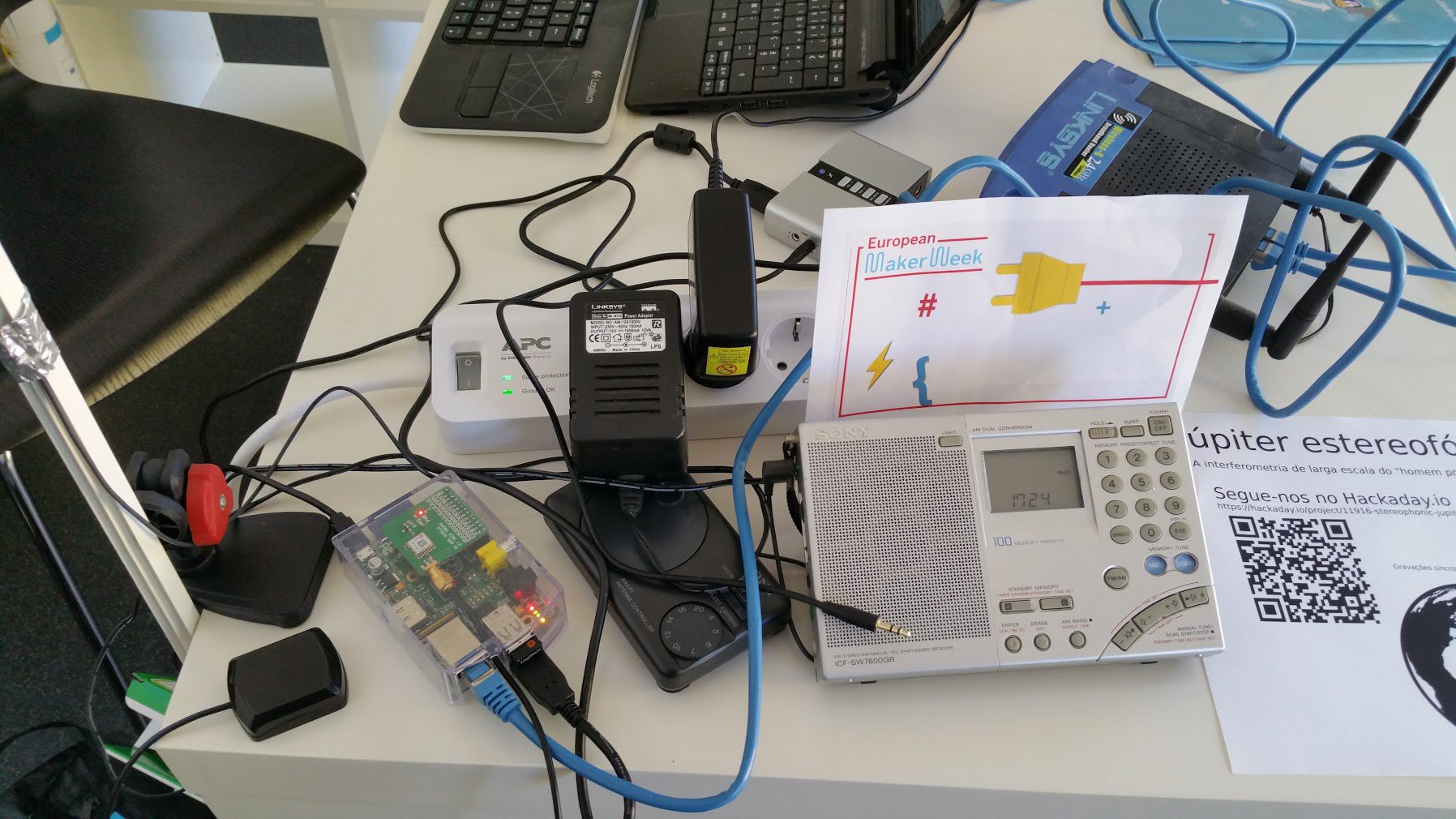
Of the things needed to make this project work, most can be acquired from vendors. The radio receivers will have to be hand made. While they are being built i decided to substitute them with a common radio shortwave receiver, so that software can be developed, systems integrated and bugs knocked off.
You can have a look at what this development hardware stack looks like:

 Natty P
 andrew.powell
 Desreverteg
 Lauren