This project aims to create various devices for a "smart home" that do not involve major changes to existing systems.
All nodes must be transparent to the existing system and can be linked together to exchange information with each other and over the internet.
Subsystems:
- Lights
- Hub
- Thermostat
- Doors / Windows
- Garden irrigation
- Intrusion alarm
The backbone of the entire system will be the ability to connect the various node, in the need of identify the best way to do so, i have selected five alternatives: > KNX > CAN > DALI > WIFI/RF > Developing a proprietary protocol based on DALI and CAN
(+) Pro (-) Cons
KNX (TP) - requires complex power supply - little choice of transceiver ICs (more expensive) + only 2 wires for bus and power supply + multimaster + line/bus, tree and star topology are allowed
CAN - requires 4 wires, two for power and two for the bus - only line/bus topology - requires termination resistance + multimaster + cheaper transceivers
DALI - Manchester encoding - master/slave (dali 1) + only 2 wires for bus and power supply + simple power supply + the interface is realizable with passive components + line/bus and star topology are allowed
WIFI/RF - requires power supply (mains) - not good if is inserted inside the wall + simple to implement + tree, star and mesh topology are allowed
Developing a proprietary protocol based on DALI and CAN (HW interface based on DALI protocol based on CAN) - everything needs to be developed (HW & SW) + only 2 wires for bus and power supply (DALI) + simple power supply (DALI) + the interface is realizable with passive components (DALI) + line/bus and star topology are allowed (DALI) + mltimaster (CAN)
The first subsystem I'm working on is the light control.
It is possible to have two cases: 1) more than one control per light point 2) a single control for light point
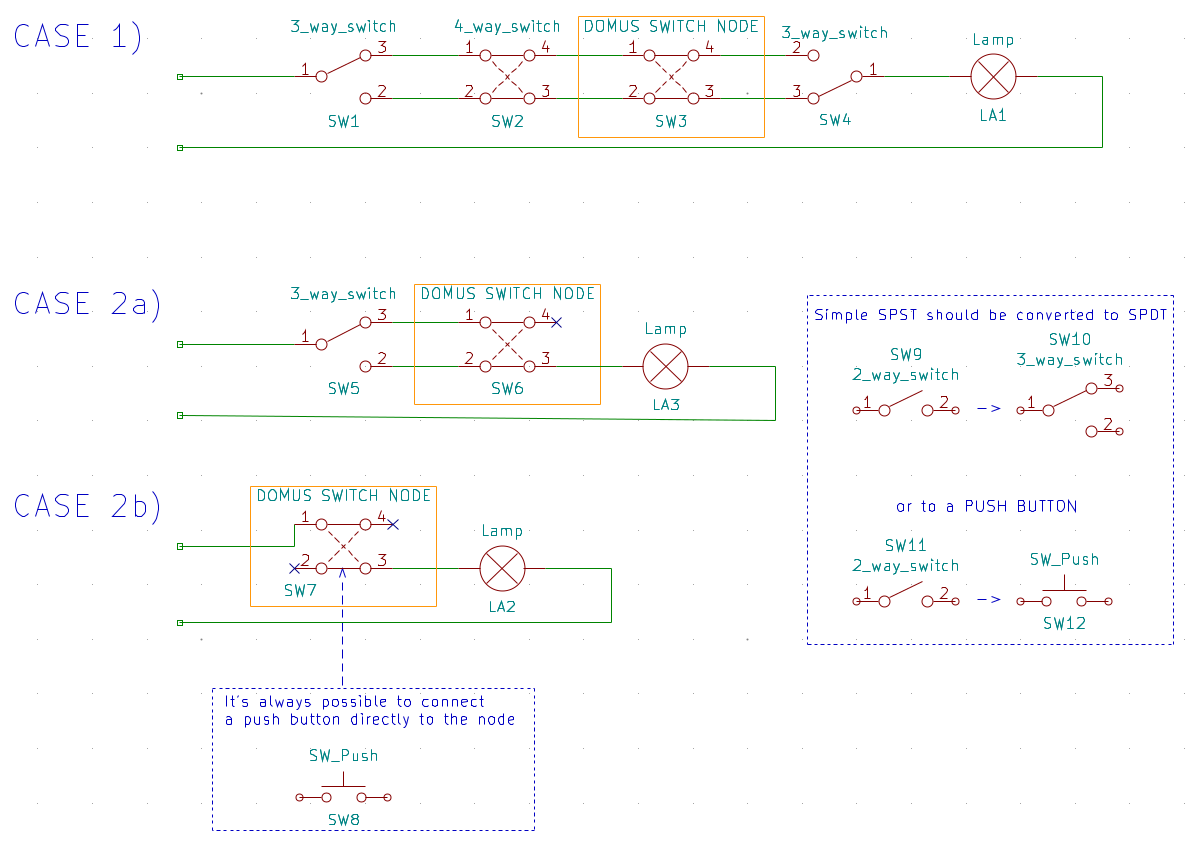
To ensure that it is possible to drive the light from any switch the node must behave as a 4 way switch.
The first case is the simplest, it is sufficient to connect the node in series to the switches [1].
The second case is slightly more tricky, it is necessary to replace the single switch with a 2-way switch and put it in series with the node [2a], or with a push-button connected directly to the node [2b].
The "SWITCH NODE" must have three functions: - switch ON/OFF the load - sense if the load is ON or OFF - communicate to receive commands and send the status of the load