Close
0%
0%

Yb³⁺ spectroscopy and qubit-control testbed

Building Quantum Devices with Yb³⁺ Ions and the BSM-SG Model

Similar projects worth following
An open experimental platform for studying the optical and microwave response of Yb³⁺-doped crystals. The project combines infrared lasers, microwave control, magnetic fields, InGaAs detection, DAQ/FPGA timing and Qiskit-based simulation. BSM-SG is used to generate additional testable hypotheses that will be compared with conventional spectroscopy and spin-Hamiltonian models. The current system is a spectroscopy and control testbed, not a completed quantum processor. Let’s find out what the hardware and the measurements actually tell us. Explore more at: https://www.bsm-sg-computing.com/from-spectra-to-coherence-bsm-sg-predictions-and-experimental-qubit-signatures-with-labview-lasers-and-ingaas-detection/

Yb³⁺ Spectroscopy and Quantum-Control Testbed

Project Overview

This project explores the optical and microwave response of Yb³⁺-doped crystals using an accessible, modular laboratory setup.

The experimental platform combines:

  • infrared laser excitation;
  • microwave-frequency sweeps and pulse control;
  • an externally applied magnetic field;
  • InGaAs photodiode detection;
  • DAQ and FPGA-based timing;
  • Python, LabVIEW and Qiskit-based data-processing tools.

The current build should be understood as a spectroscopy and control testbed, not as a completed quantum computer.

Its purpose is to characterize the hardware, establish a reliable measurement chain and investigate whether repeatable spin-dependent or coherence-related signals can be detected in the selected Yb³⁺ material.

Current Project Status

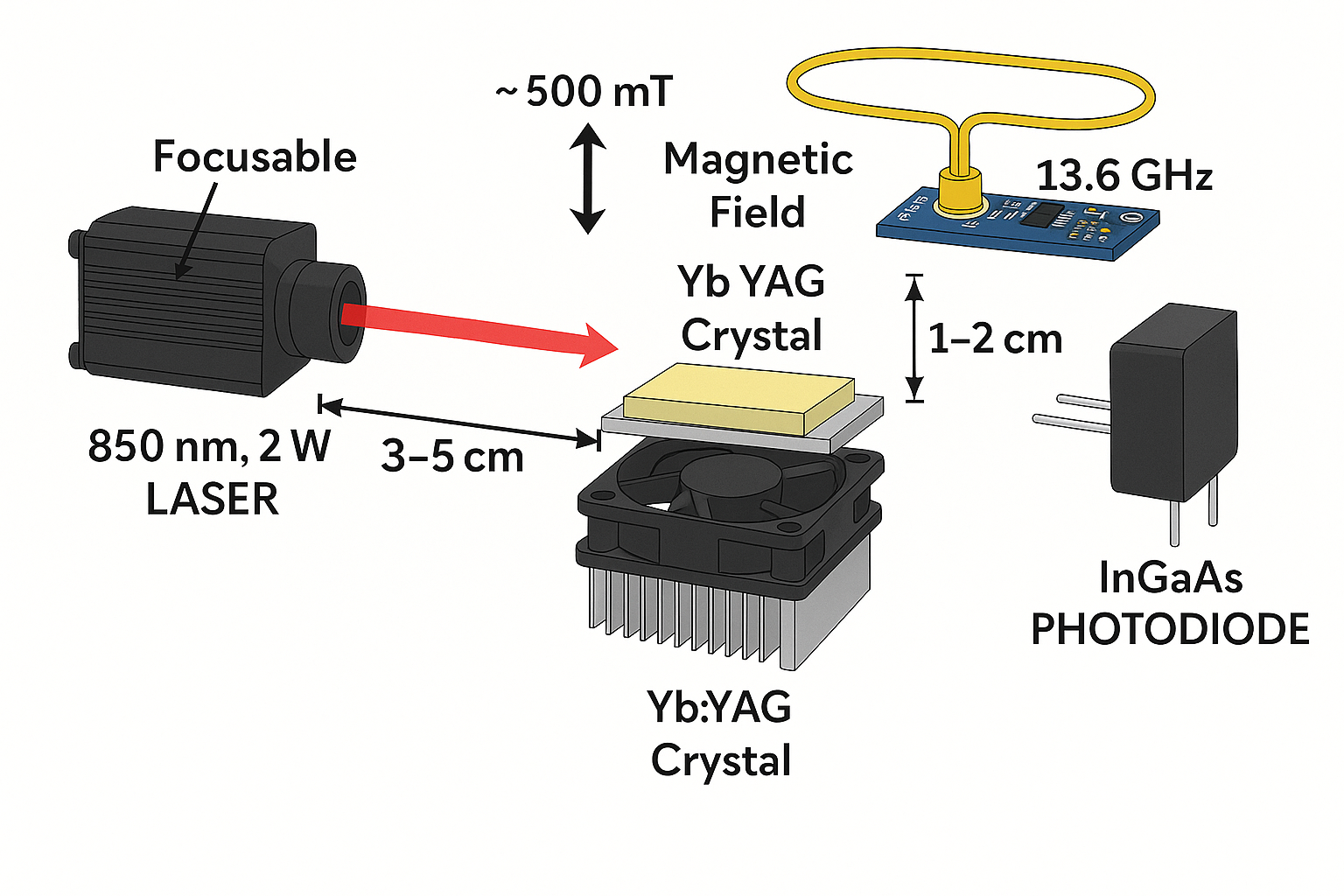
A hardware platform is being assembled around Yb³⁺-doped crystal samples, infrared laser modules, a microwave signal generator, magnetic-field control, an InGaAs detector and a USB DAQ.

The software currently includes Qiskit simulations of multi-qubit circuits. These simulations are used to develop control logic, pulse sequences and data-handling workflows. They do not represent physical qubits already operating in the crystal.

The analog voltage measured by the photodiode is treated as an experimental optical signal. It will only be interpreted as evidence of a quantum or spin transition after appropriate calibration, control measurements and statistical analysis.

The immediate experimental work focuses on:

  • measuring the optical spectrum and detector noise floor;
  • characterizing laser stability and wavelength;
  • calibrating the microwave and magnetic-field systems;
  • testing whether microwave-frequency sweeps produce repeatable optical changes;
  • investigating pulse-dependent responses;
  • separating genuine sample responses from thermal, electrical and optical artifacts.

Experimental Goals

The project aims to develop a documented platform that can be used to investigate:

  1. optical absorption and emission from Yb³⁺-doped materials;
  2. magnetic-field-dependent spectral changes;
  3. microwave-driven transitions;
  4. optically detected magnetic resonance, where supported by the material and transition;
  5. pulse sequences associated with Rabi, Ramsey, T₁ and T₂ measurements;
  6. integration between laboratory instruments and quantum-control software.

These measurements require considerably more than observing a change in photodiode voltage. A candidate signal must be repeatable, correlated with a controlled experimental parameter and distinguishable from the measured noise and background response.

The Role of BSM-SG

BSM-SG is included in this project as a hypothesis-generating structural model.

It is not used as a replacement for quantum mechanics, established spectroscopy or conventional spin-Hamiltonian analysis. It does not remove the need for stable lasers, calibrated microwave sources, temperature control or careful experimental validation.

The proposed role of BSM-SG is to generate candidate predictions concerning:

  • resonance-frequency regions;
  • preferred magnetic-field orientations;
  • possible structural anisotropies;
  • relationships between nuclear structure and magnetic response;
  • material and isotope selection;
  • experimental parameter ranges worth investigating.

Where possible, these predictions will be expressed quantitatively before the corresponding measurements are performed.

The experimental results will then be compared with both:

  • conventional crystal-field and spin-Hamiltonian models; and
  • the additional predictions proposed by BSM-SG.

A familiar effect such as an ODMR resonance, Rabi oscillation or Ramsey fringe would not by itself validate BSM-SG. Such effects are already described by established quantum theory.

For BSM-SG to provide additional scientific value, it must produce a specific, testable prediction that is confirmed experimentally and performs at least as well as, or better than, the conventional...

Read more »
yb_spectroscopy_testbed_v2.py

Experimental Monitoring and Data Acquisition Software The Python software has been expanded from a basic two-channel oscilloscope display into a more complete experimental monitoring and data-acquisition tool. The updated version includes: * a corrected sampling rate of **50 kS/s**, allowing spectral components up to approximately 25 kHz to be observed; * Hann-windowed, properly scaled single-sided FFT analysis; * automatic DC-offset and linear-drift removal; * exponential moving average smoothing of the measured spectrum; * separate averaged spectra for microwave **ON** and **OFF** conditions; * direct comparison between the microwave ON and OFF measurements; * robust noise-floor estimation using the median and median absolute deviation; * signal-to-noise ratio calculation; * automatic identification of candidate spectral features; * exclusion of 50 Hz mains interference and its harmonics from automatic candidate detection; * manual baseline acquisition; * continuous CSV logging of

x-python - 29.56 kB - 07/27/2026 at 08:15

Download

bsm-sg-photodiodes-full.py

This script implements a hybrid quantum-classical control routine for a Yb³⁺-based quantum processor, inspired by BSM-SG theory. It performs the following key functions: Calculates the spin transition frequency for ytterbium ions in a magnetic field using BSM-SG constants. Controls a microwave signal generator to emit a precise ~10 GHz frequency for qubit manipulation. Constructs a 16-qubit quantum circuit in Qiskit, simulating entanglement and rotation gates that represent real spin and optical transitions (1030 nm and microwave). Reads analog voltage data from a DAQ card (e.g., photodiode output). Executes the circuit using Qiskit’s Aer simulator and prints both quantum results and measured voltage. Gracefully powers off the microwave generator after operation. This code is part of our open-hardware stack for quantum neural networks built on a physical ion-crystal substrate.

x-python - 9.80 kB - 07/20/2026 at 11:39

Download

qubit_comparison_report.pdf

Qubit comparison report.

Adobe Portable Document Format - 50.04 kB - 10/03/2025 at 09:33

Preview

expected_spectra_pack.pdf

Expected spectrums detected by NI spectrum analyzer.

Adobe Portable Document Format - 29.85 kB - 10/03/2025 at 09:33

Preview

yb.py

Code Overview This script implements a hybrid quantum-classical control routine for a Yb³⁺-based quantum processor, inspired by BSM-SG theory. It performs the following key functions: Calculates the spin transition frequency for ytterbium ions in a magnetic field using BSM-SG constants. Controls a microwave signal generator to emit a precise ~10 GHz frequency for qubit manipulation. Constructs a 16-qubit quantum circuit in Qiskit, simulating entanglement and rotation gates that represent real spin and optical transitions (1030 nm and microwave). Reads analog voltage data from a DAQ card (e.g., photodiode output). Executes the circuit using Qiskit’s Aer simulator and prints both quantum results and measured voltage. Gracefully powers off the microwave generator after operation. This code is part of our open-hardware stack for quantum neural networks built on a physical ion-crystal substrate.

x-python - 2.36 kB - 04/07/2025 at 13:54

Download

View all 11 files

  • 1 × THORLABS - SM05PD6A - Mounted InGaAs Photodiode, 800-1700 nm, Cathode Grounded
  • 2 × 1030nm and 850nm 100mW/200mW Infrared Solid-State Laser Module+ Adjustable Power Supply
  • 1 × 10MHz – 15GHz Dual Channel Microwave RF Signal Generator
  • 1 × Yb:Yag Crystals
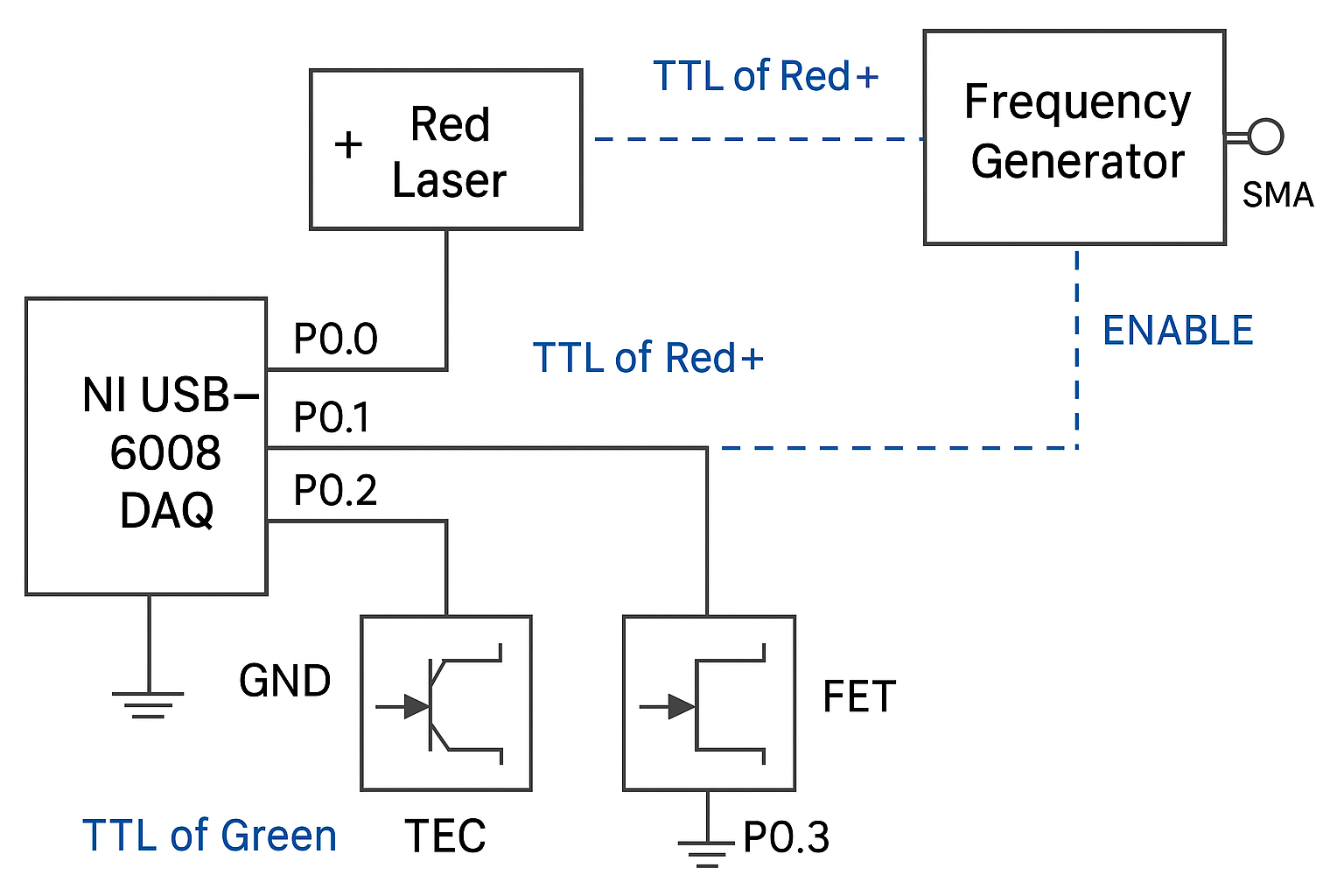
  • 1 × DAQ Card

View all 7 components

  • BSM-SG Predictions and Experimental Qubit Signatures with LabVIEW, Lasers, and InGaAs Detection

    Victor Pronchev • 07/22/2026 at 09:33 • 0 comments

     How to Reproduce in LabVIEW

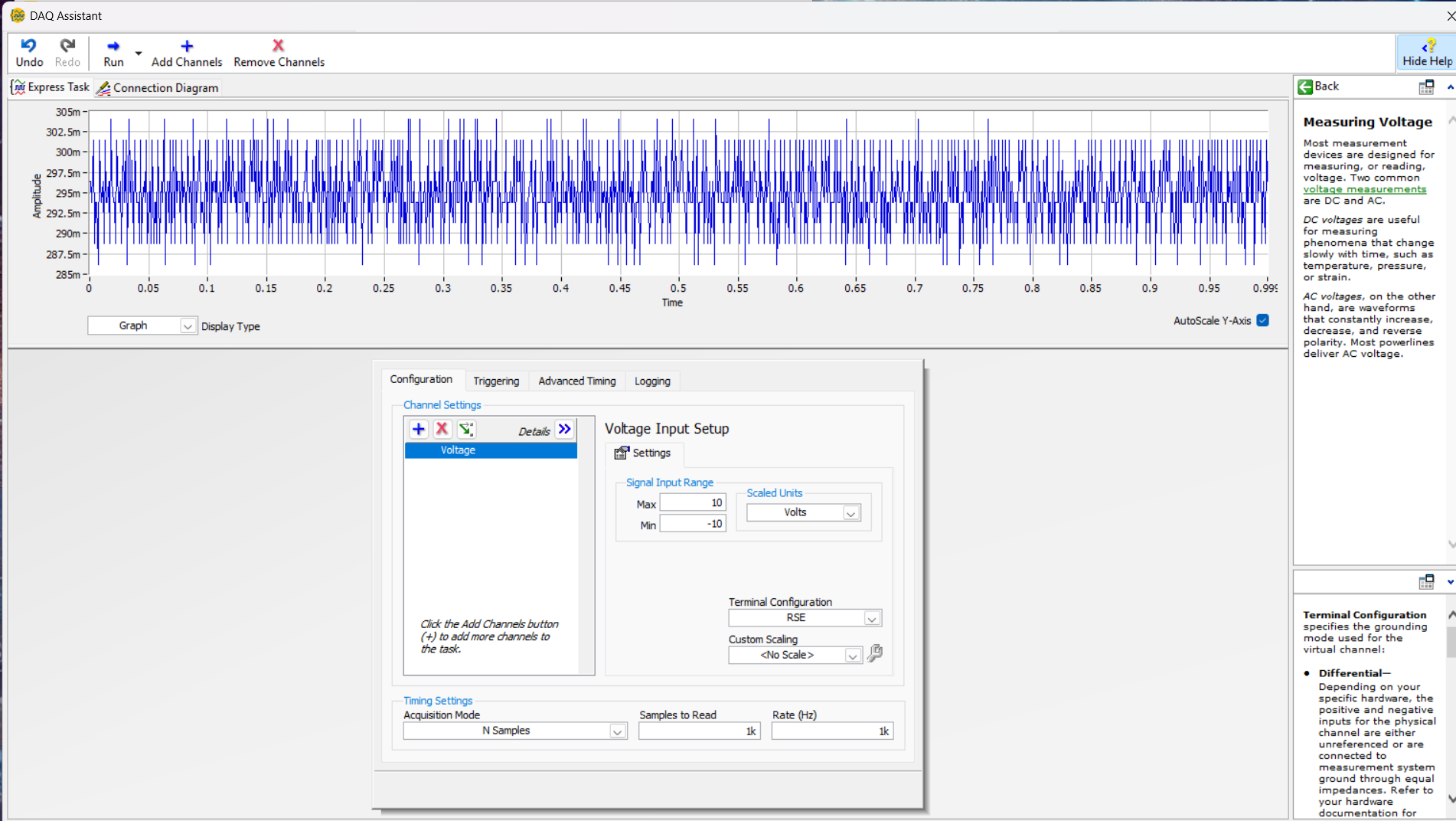
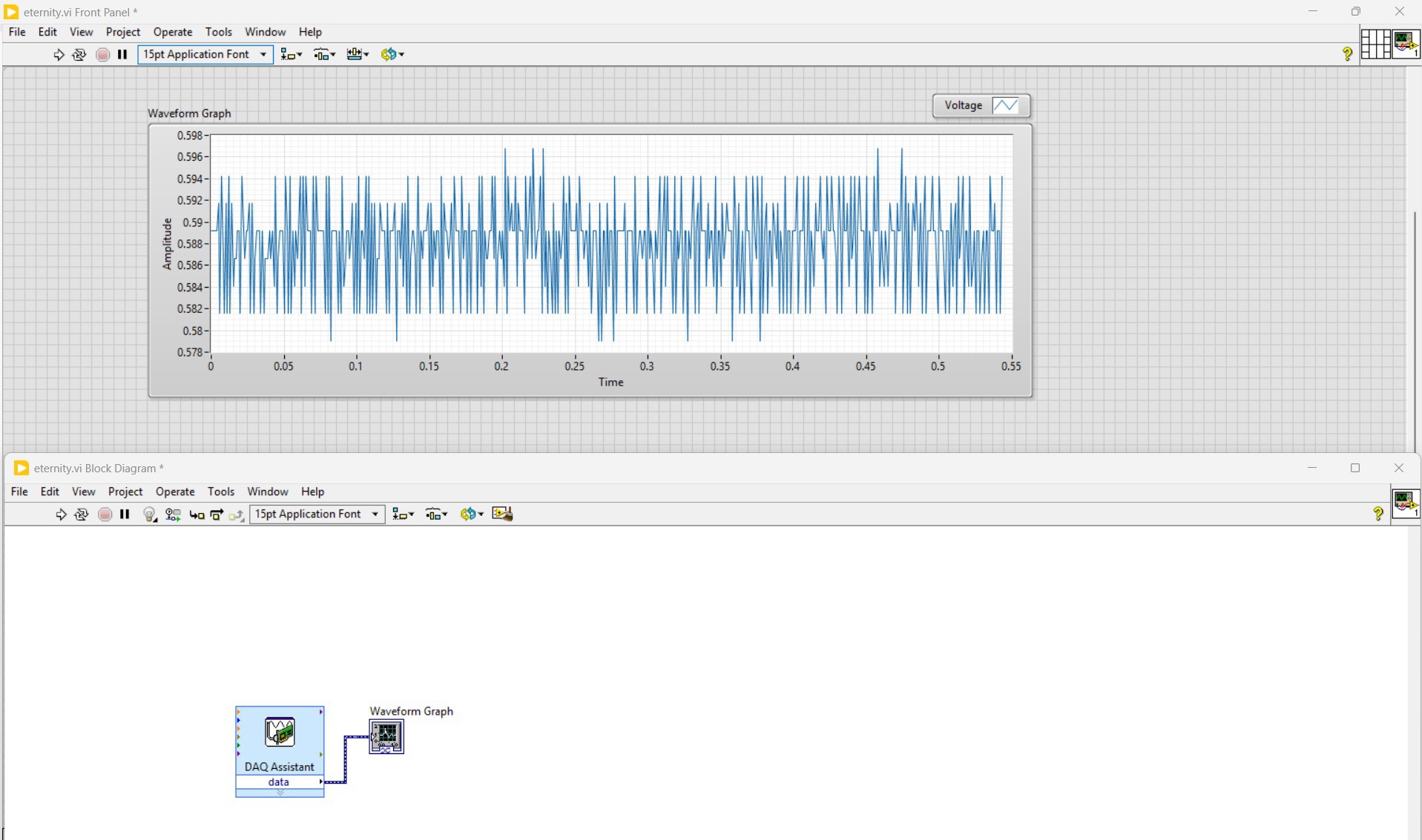
    • ODMR: Sweep microwave frequency → read PD via DAQ → XY Graph.
    • Rabi: TTL pulse-width sweep → read PD post-pulse.
    • T1: π-pulse → wait τ → measure PD.
    • Ramsey: π/2 – wait τ – π/2 sequence → observe fringes.
    • Spectra: via USB-NIR spectrometer or DAQ-driven FFT.

     BSM-SG Interpretation of Results

    • ODMR dips validate resonance predicted by FOHS geometry.
    • Rabi oscillations reveal coherent nutations stabilized by Cosmic Lattice.
    • T1/T2 lifetimes longer than Standard Model expectations.
    • Spectral coherence confirms lattice-stabilized energy transfer.

    These outcomes suggest that Eternity Cubeits, built from structured matter principles, can sustain coherence at scales unachievable in conventional frameworks.

  • Video Log

    Victor Pronchev • 06/12/2025 at 13:59 • 0 comments

    Sending the correct frequencies from the microwave generator increases the output voltage from the InGaas Photodiode.

  • Video Log

    Victor Pronchev • 06/12/2025 at 13:57 • 0 comments

View all 3 project logs

  • 1
    Architecture Overview
  • 2
    Logic
  • 3
    DAQ

View all 3 instructions

Enjoy this project?

Share

Discussions

Similar Projects

Does this project spark your interest?

Become a member to follow this project and never miss any updates