 caspar
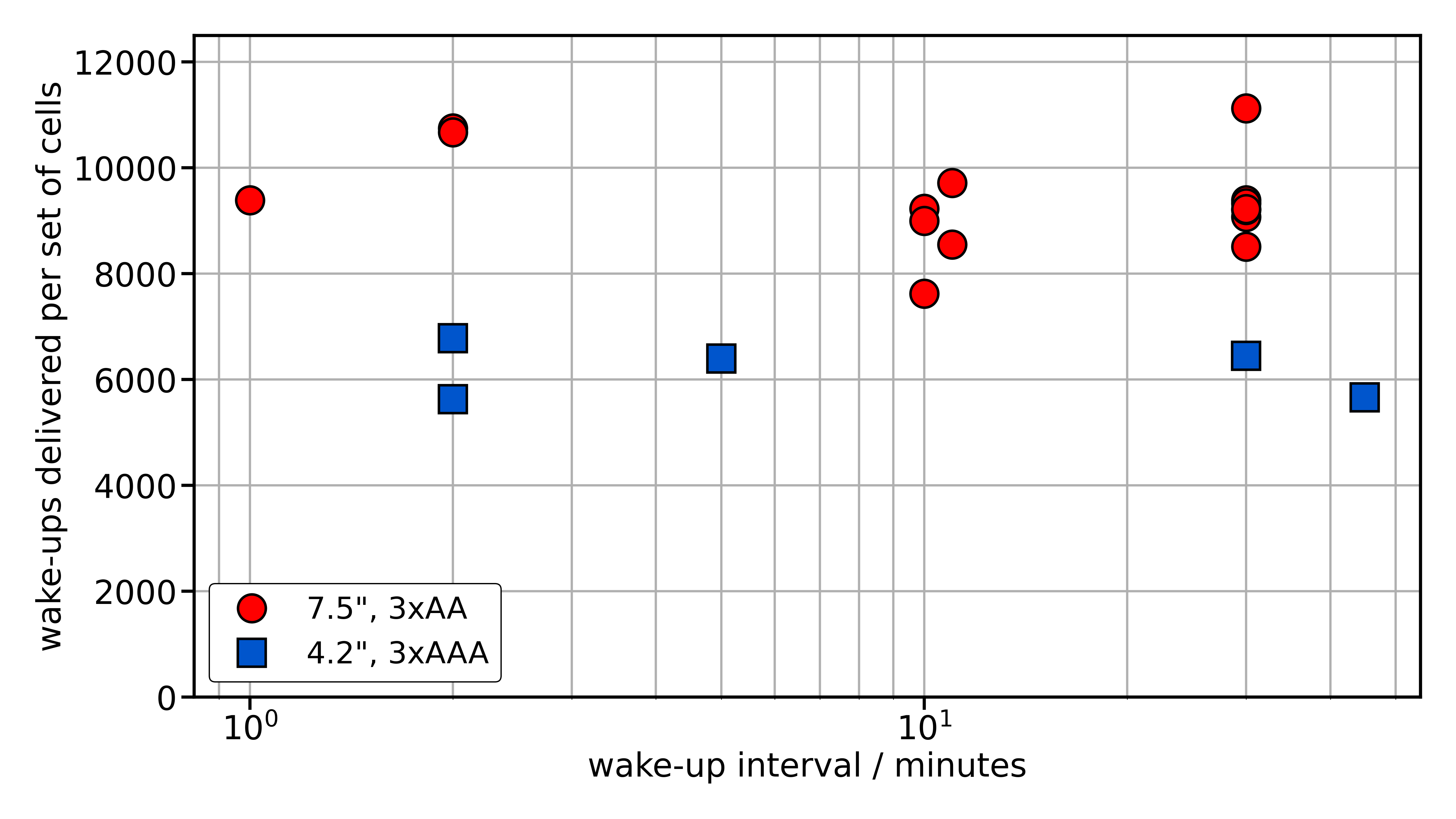
Tinta's low power consumption relies on switching itself completely off between wake-ups. An easy way to see whether that works in practice is to look at how the lifetime scales with the wake-up interval — or, put differently, whether a set of batteries delivers the same number of wake-ups whether Tinta wakes every two minutes or once an hour. In the very first log of this project I tested exactly that, with intervals of 2 and 30 minutes, and wrote that "battery lifetime is not limited by power consumption in the off-state for these refresh times" and that "lifetimes in the range of years are realistic". That rested on two runs of 15 and 198 days: two points and a straight line through them.
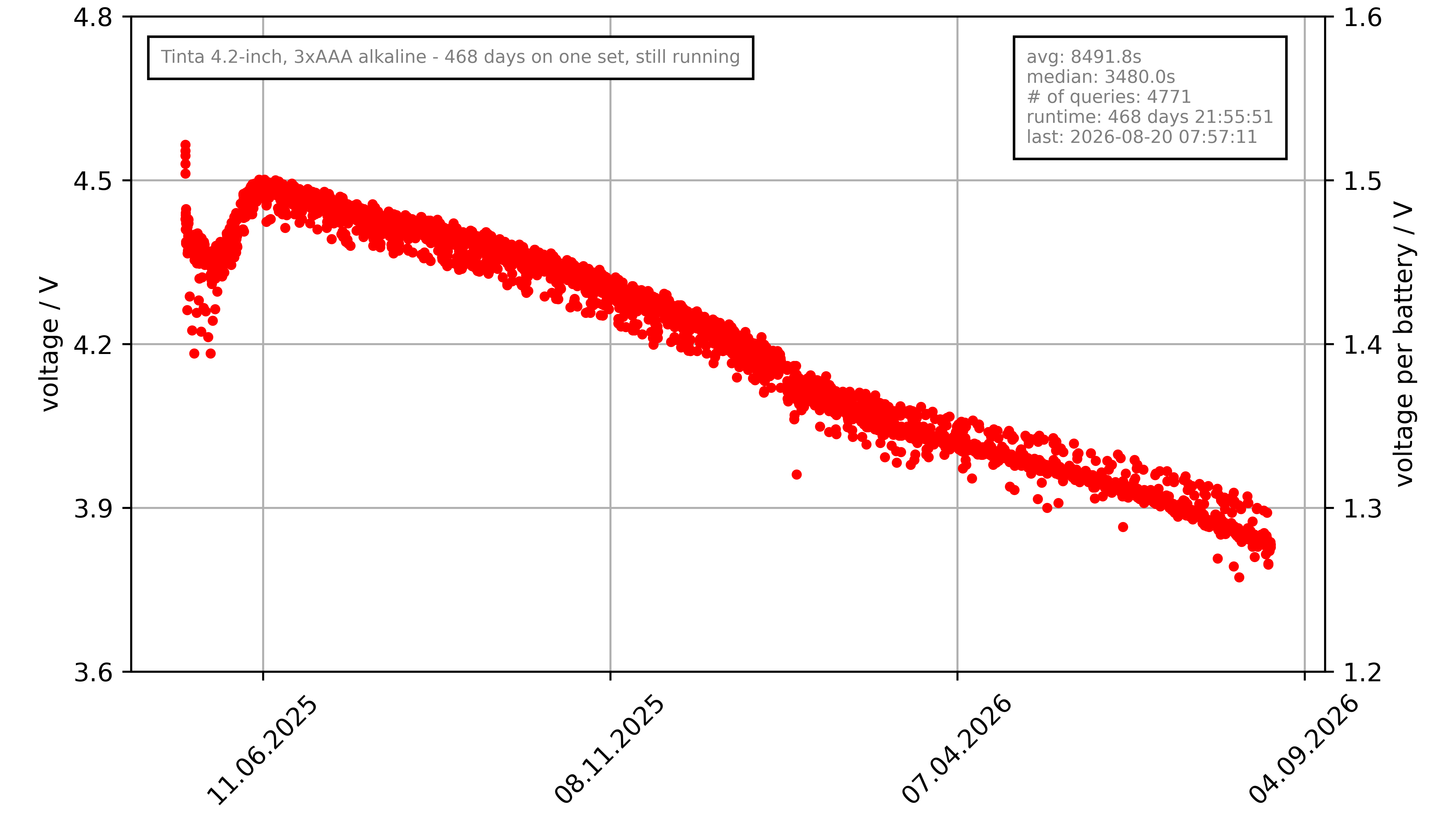
A year later I have much longer runs and more data to check it against. One device has now been on the wall for 468 days on the set of cells it was built with, still going, and another managed 433 days and 5,665 wake-ups before it stopped. That sits nicely on the roughly 5,000 wake-ups per set the 4.2-inch version was designed for, and the 7.5-inch version reaches about 10,000 on its larger AA cells. Note that some of the devices only wake during office hours to save power, which is why the same wake-up budget stretches over more calendar days on some units than on others.
This picture is confirmed by looking at the data of all devices in operation up to now. A set of cells delivers a roughly fixed number of wake-ups, and how often the device wakes barely moves it, as you can see in the figure. The energy goes into waking up, connecting and refreshing the panel, and almost none of it into the time in between.
### Why alkaline?
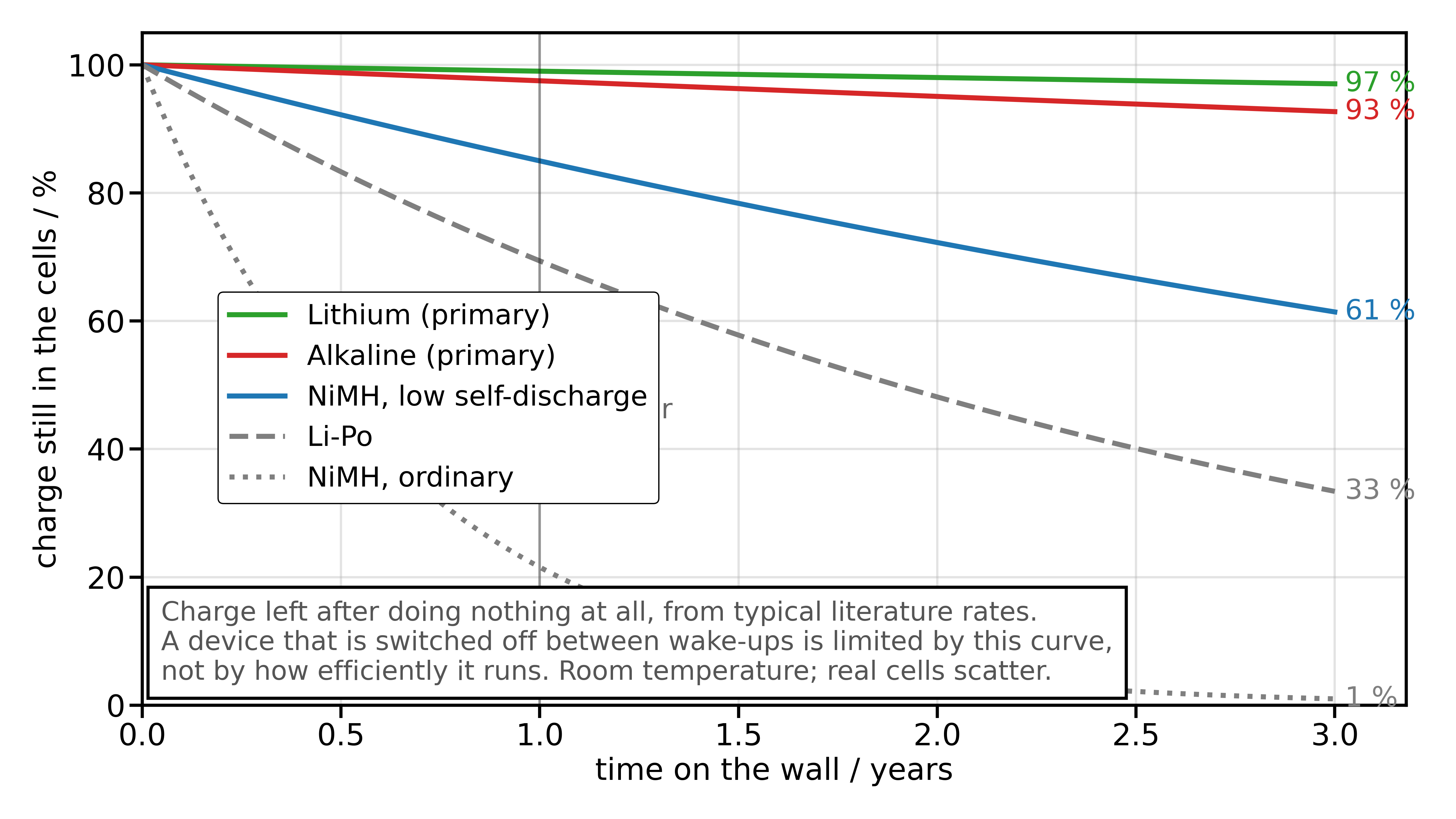
Rechargeable batteries are the obvious choice for a device like this, and for this one they are the wrong choice. When nothing is drawn between wake-ups, the limit is no longer the electronics but the chemistry: cells lose charge on their own whether the device uses them or not. Alkaline cells are cheap, sold everywhere, and happen to be very good at exactly that.
| Cell type | Typical self-discharge | Charge left after 1 year | After 3 years |
|---|---|---|---|
| Lithium, non-rechargeable | ~1 % per year | 99 % | 97 % |
| Alkaline, non-rechargeable | ~2.5 % per year | 97 % | 93 % |
| NiMH, low self-discharge | ~15 % per year | 85 % | 61 % |
| Li-Po / Li-ion | ~3 % per month | 69 % | 33 % |
| NiMH, ordinary | ~12 % per month | 22 % | 1 % |
Typical literature values at room temperature. After a year on the wall an alkaline cell still holds almost all of its charge, while an ordinary NiMH is down to a fifth, having powered nothing at all. Over three years it is empty. Only lithium primaries do better than alkaline, and not by much.
### What is next?
Very long lifetimes should be attainable at very rare wake-up, and in combination with Lithium. Of course, if charging once per year or so is fine, Tinta can also be used with rechargeable batteries. In any case, a small Python script in the repository, `hardware/circuit/power_consumption_estimate.py` can be used to estimate lifetime, backed by in-field data.
Discussions
Become a Hackaday.io Member
Create an account to leave a comment. Already have an account? Log In.