 Akshay Jain


This project demonstrates how to build a browser-based GPS tracker using the Heltec WiFi LoRa 32 V4 development board and the REYAX RYS352A Multi-GNSS module. The tracker receives real-time location data from multiple GNSS satellite constellations, displays the current latitude, longitude, and connected satellite count on the onboard OLED display, and hosts a lightweight web server that allows any device connected to the same Wi-Fi network to monitor the tracker's live location through a web browser. Unlike many GPS tracking projects, this implementation does not rely on any third-party cloud platform or external server.
Project Features
- Multi-GNSS receiver (GPS, GLONASS, Galileo, BeiDou & QZSS)
- Browser-based live tracking
- Interactive OpenStreetMap interface
- No cloud platform required
- OLED displays GPS information
- Embedded web server
- Minimal hardware connections
- Real-world tested in a moving vehicle
The project is ideal for learning GNSS communication, ESP32 networking, UART communication, embedded web servers, and browser-based visualization. It also serves as a foundation for more advanced applications such as vehicle tracking, fleet management, geofencing, asset monitoring, robotics, and IoT location tracking.
Hardware Required
- Heltec WiFi LoRa 32 V4 Development Board
- REYAX RYS352A Multi-GNSS Module
- Breadboard
- Breadboard Power Supply Module
- 12 V Lithium Battery
- USB Type-C Cable
- Jumper Wires
Software Required
- Arduino IDE
- Heltec ESP32 Board Package
- TinyGPS++ Library
- WiFi Library
- WebServer Library
Circuit Connections
The hardware requires only a few connections between the Heltec board and the GNSS module.
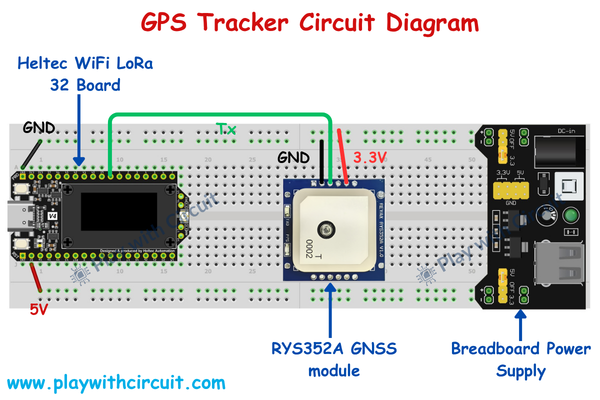
The RYS352A GNSS module can also be connected directly to the dedicated GNSS Molex connector available on the Heltec WiFi LoRa 32 V4 board, reducing external wiring and simplifying the overall hardware assembly.
How the Project Works
After powering the system, the Heltec WiFi LoRa 32 V4 connects to the configured Wi-Fi hotspot and starts an embedded web server. At the same time, the REYAX RYS352A Multi-GNSS receiver begins acquiring satellite signals and continuously transmits NMEA data to the Heltec board through UART communication.
The firmware parses the incoming NMEA sentences using the TinyGPS++ library to extract the current latitude, longitude, and connected satellite count. These values are displayed on the onboard OLED while the ESP32 simultaneously serves a browser-based tracking webpage.
Any smartphone, tablet, or computer connected to the same Wi-Fi network can access the webpage by entering the IP address displayed on the OLED. The browser automatically updates the current location on an interactive OpenStreetMap interface, while the travelled path is continuously recorded and displayed as the tracker moves.
Testing
The completed GPS tracker was tested outdoors by placing the hardware inside a moving vehicle and driving through different locations. Once the GNSS receiver acquired sufficient satellites, the OLED displayed the live latitude, longitude, and satellite count, while the browser-based interface updated the current position in real time.
Throughout the test, the location marker accurately followed the vehicle's movement, and the travelled route was continuously plotted on the OpenStreetMap interface. The project demonstrated reliable positioning and stable browser-based tracking without relying on any external cloud service.
Applications
- Vehicle Tracking
- Fleet Management
- Asset Tracking
- Robotics
- Outdoor Navigation
- IoT Location Monitoring
- Educational Embedded Systems Projects
- Personal Tracking Devices
Future Improvements
This project can be further enhanced by adding features such as geofencing alerts, LoRa communication, SD card logging, Home Assistant integration, mobile application support, OTA firmware updates, and cloud synchronization for remote monitoring.
For complete tutorial visit Play with Circuit.
About Play with Circuit
PlayWithCircuit is an educational platform dedicated to Arduino, ESP32, embedded...
Read more »
 voidrane Splicer

 CiferTech

 IOTMCU