 ElectroScope Archive


Introduction
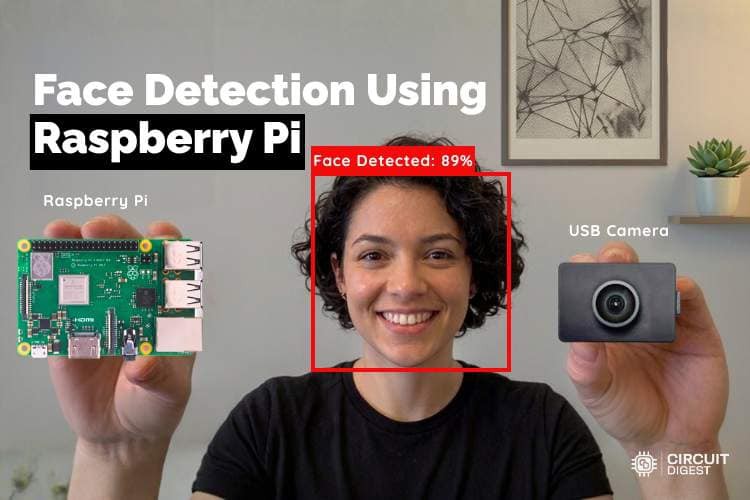
Many IoT surveillance systems rely entirely on cloud processing, introducing network delays and privacy concerns. Running face detection directly on the Raspberry Pi significantly reduces latency because image processing happens locally.
Only the useful information, such as whether a face was detected and when the event occurred, is transmitted to the cloud. This hybrid architecture minimises bandwidth usage while keeping the dashboard updated in near real time.
Features
- Real-time face detection using OpenCV
- Raspberry Pi edge processing
- USB webcam support
- Cloud dashboard integration
- Live detection status updates
- Detection event logging
- Python-based implementation
- Easy to customize for future AI models
Hardware
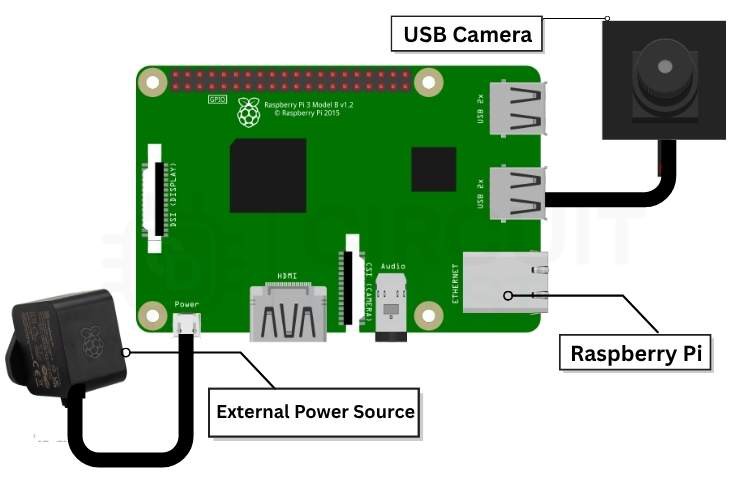
- Raspberry Pi 4 (or Raspberry Pi 3 with reduced frame rate)
- USB webcam
- MicroSD card
- 5V Raspberry Pi power supply
- Internet connection
Software
- Raspberry Pi OS
- Python 3
- OpenCV
- NumPy
- Cloud dashboard account
- Camera drivers
How It Works
The USB camera continuously captures video frames.
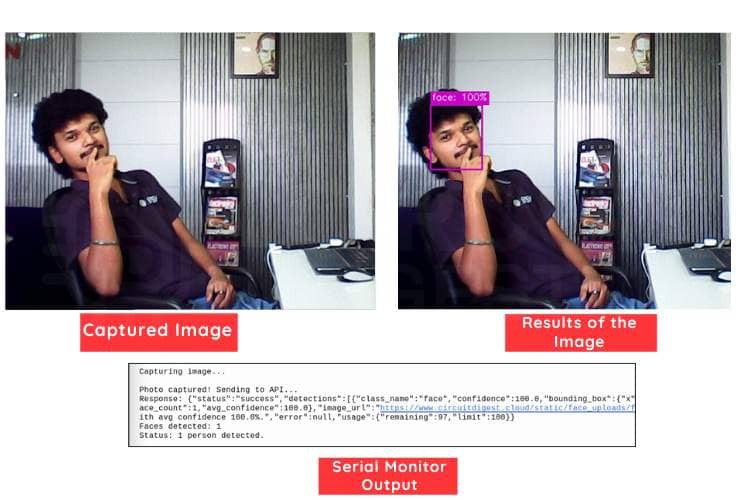
Each frame is processed locally using OpenCV's Haar Cascade face detector. Whenever one or more faces are identified, the software records the detection event and updates the cloud dashboard.
The cloud service stores the latest detection status, allowing users to monitor activity remotely without streaming continuous video.
The processing pipeline is:
Camera → Raspberry Pi → Face Detection → Cloud Update → Remote Dashboard
Software Workflow
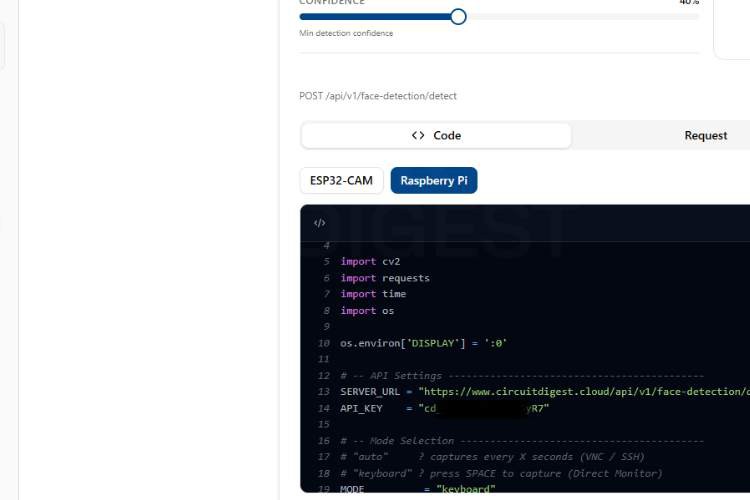
- Initialize the camera.
- Load the trained face detection model.
- Capture video frames.
- Convert each frame to grayscale.
- Detect faces.
- Draw bounding boxes around detected faces.
- Send detection status to the cloud.
- Continue processing until the application is stopped.
Challenges
Several practical issues appeared during development:
- Maintaining acceptable frame rates on lower-end Raspberry Pi models.
- Balancing detection accuracy with CPU utilization.
- Handling changing lighting conditions.
- Avoiding excessive cloud updates by transmitting only meaningful events.
- Keeping the system responsive while continuously processing video.
Optimizing the image resolution and limiting unnecessary network traffic helped improve overall performance.
Possible Improvements
The project can be extended in several interesting directions:
- Face recognition for known individuals
- Motion detection before running AI inference
- Email or mobile notifications
- MQTT integration
- Object detection with TensorFlow Lite
- Mask detection
- Visitor counting
- Person tracking
- Home automation triggers
- Local database logging
Applications
- Smart home monitoring
- Office entry monitoring
- Classroom occupancy detection
- Visitor analytics
- Prototype security systems
- Educational computer vision projects
- IoT and AI learning platform
What I Learned
This Raspberry Pi Face Detection project demonstrates that useful AI applications no longer require powerful desktop computers. A Raspberry Pi is capable of performing real-time computer vision while remaining connected to cloud services for monitoring and visualization.
The most valuable lesson was understanding how edge computing and cloud platforms complement each other. Processing images locally keeps response times fast, while the cloud provides convenient remote access to system status without transmitting large amounts of video data.
Future Work
Future versions could replace Haar Cascade detection with modern deep-learning models, improve performance using hardware acceleration, and integrate multiple sensors for smarter decision-making. A web interface for live configuration and analytics would also make the system more practical for long-term deployments.
This project serves as a foundation for experimenting with embedded AI, computer vision, and connected IoT Projects using affordable hardware.
Looking for your next build? Check out these AI projects and tutorials alongside a collection of simple Raspberry Pi projects for beginners to expand your maker journey.
 Himanshu Dada

 Aswinth Raj
 ecd1012