 Tom Green
Introduction
I love wild camping. I've been doing it for fifteen years, and I also love finding new ways to experience and connect with nature. So when an opportunity came up in my busy schedule for a two-night wild camp to watch the partial (90%) solar eclipse, I naturally started wondering - could I capture it in some way?
I had an M5Stack Cardputer that had been sitting on my desk for a while, waiting for a project, along with an I²C temperature, humidity and pressure sensor. But as an eclipse is inherently a visual phenomenon, measuring light seemed much more fitting. Unfortunately, I didn't have a light sensor, and there wasn't enough time before the trip to get one delivered. So I raided my parts bin and found an LDR...
Making an LDR Work
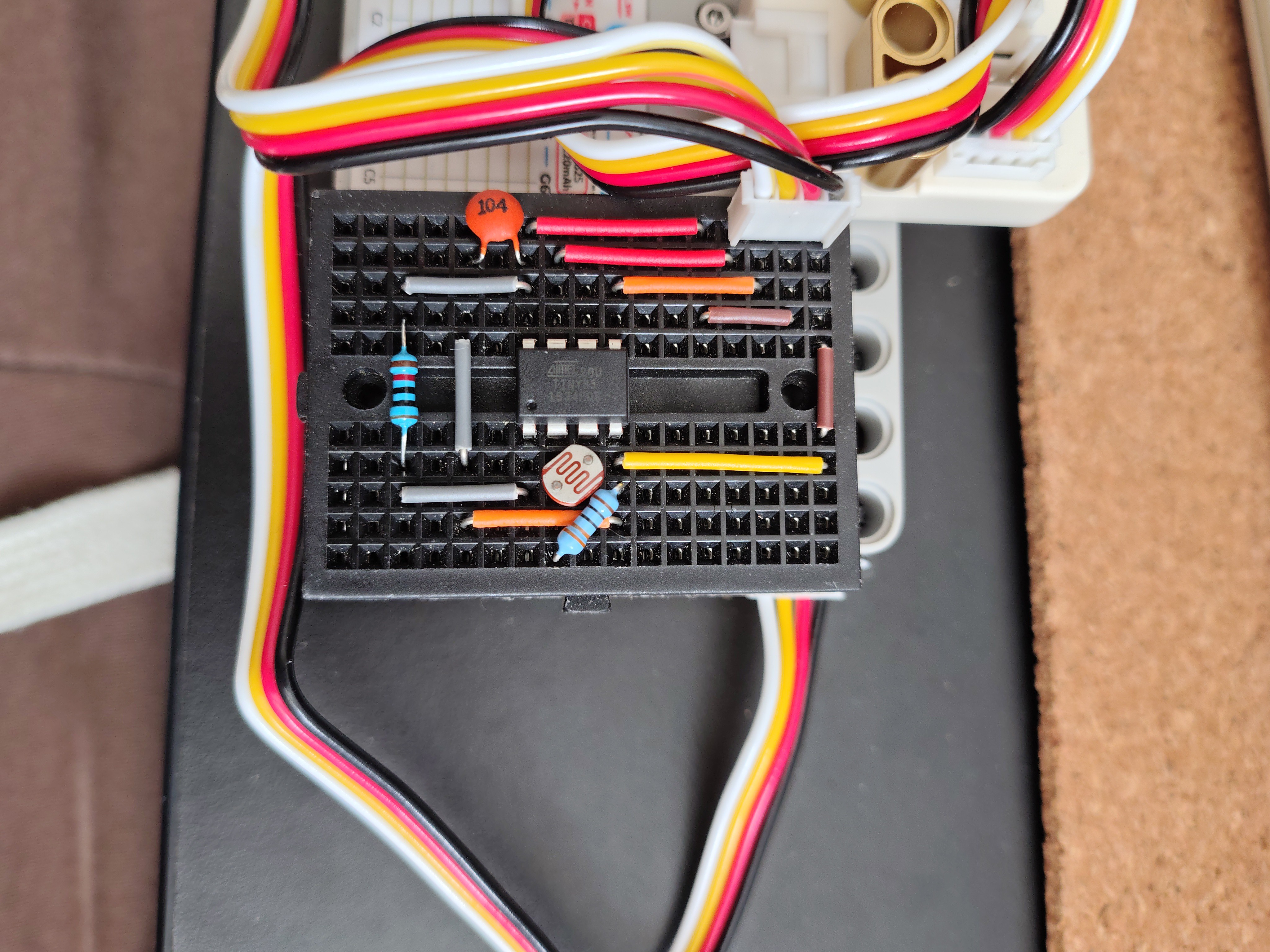
Being primarily an I²C device, the Cardputer doesn't conveniently expose an analogue input that I could connect an LDR to through a simple voltage divider. I did, however, have a handful of ATtiny85s in my parts bin.
So I had the idea of using one of those instead. The ATtiny85 could read the analogue voltage from the LDR circuit, then pass the resulting light value to the Cardputer over I²C.
I prototyped a small circuit on a breadboard - I'd planned to transfer this onto veroboard but ran out of time so I kept it as is. I left a long lead on it to enable me to choose the best position for the sensor.
I used an Arduino Uno to programme the ATtiny85 and, after an evening's coding and one small mishap involving a chip seated the wrong way around, got the two devices talking.
The ATtiny85 measured the voltage from the LDR circuit and converted it to a single-byte value (0–255), which it sent to the Cardputer over I²C. The Cardputer then timestamped each reading and logged it to a CSV file on its SD card.
I didn't have any useful specifications for the LDR, so choosing the resistor for the voltage divider was by trial and error. I tried several values and looked at the range produced between my approximate versions of "dark" (thumb over the sensor) and "bright" (phone torch pointed directly at it). Once I had a useful spread of values across the 0–255 range, that was good enough for the experiment. As I was looking to observe 'relative changes in light level' I didn't do any kind of calibration or conversion to anything like 'lux'.
The Logger
I programmed the Cardputer using the Arduino IDE. At power-on it prompts me to enter the date and time, followed by the sampling interval. From then on it takes a reading from all four sensors at each interval and writes them to a timestamped CSV file on the SD card.
The idea was to keep it simple - set it up at the start of the experiment, leave it running, and come back for the sweet sweet data afterwards.
Into the wild
I headed out into the Dark Peak, with a forecast of hot weather and clear skies. After spending some time rehydrating after the hike in, I climbed to the top of the nearest hill and hunted around for somewhere to deploy the logger.
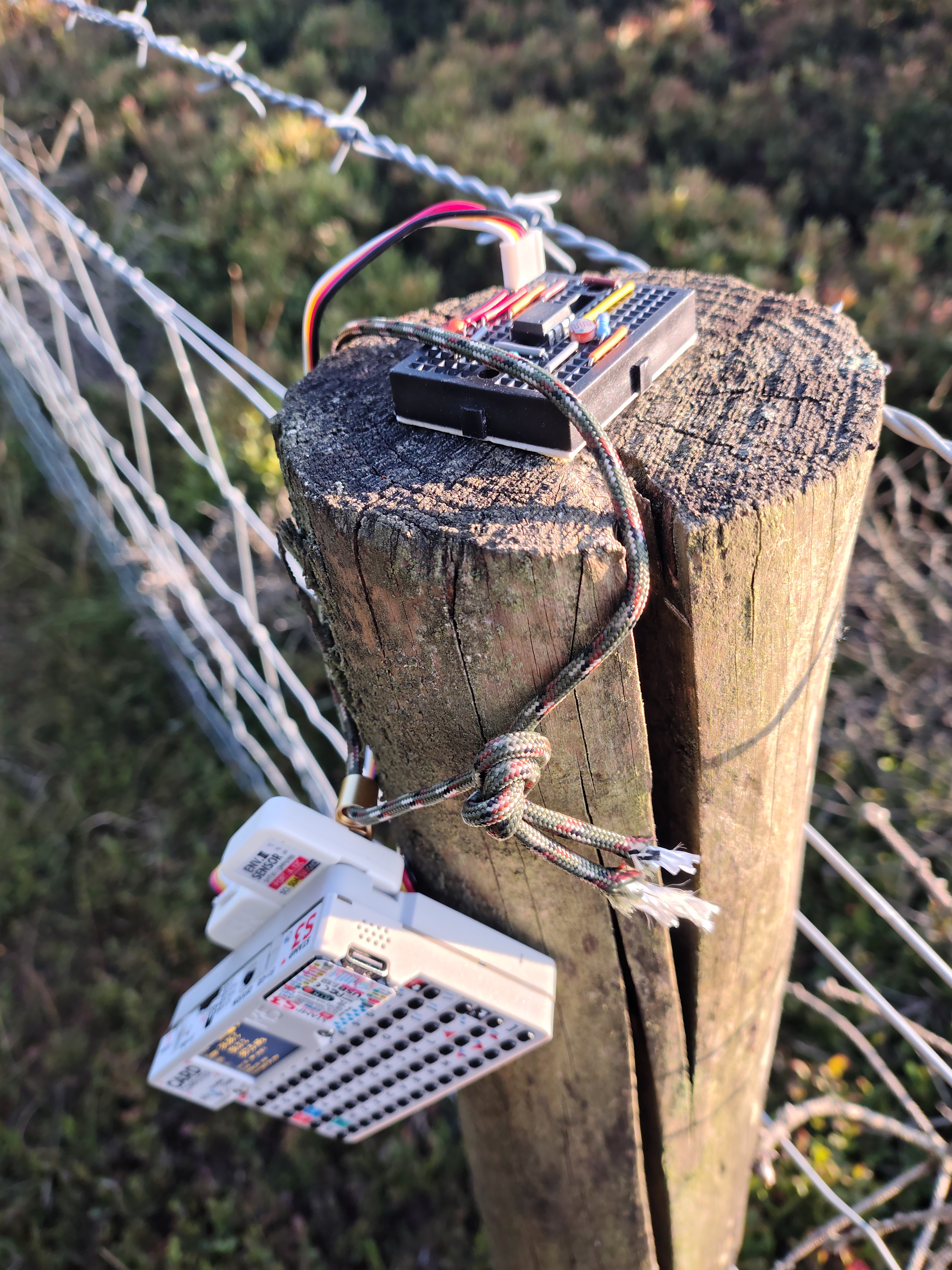
I found a fence post in an ideal location and secured the light sensor on top, pointing directly upwards at the sky. I suspended the Cardputer and the other sensors underneath with a length of paracord, keeping them out of direct sunlight.
I set the Cardputer to take a sample every 60 seconds, started the logger and then left it alone to do its job while I watched the eclipse.
The Eclipse
The eclipse itself was a surreal experience, watching the Moon slowly take a bite out of our nearest star. At 19:10, at its peak, the light had a strange quality to it, casting an odd glow across the trees.
A quick glance at the Cardputer's screen showed a much lower light-level reading, which was reassuring, although I'd have to wait until I got home the following day and plotted the CSV data to really know how well it had performed.
Satisfied, I carefully packed up my equipment and retired for a rehydrated salmon pasta and to watch the Perseid meteor shower.
The Result
After pulling the SD Card, crossing my fingers and importing the CSV into a spreadsheet...
It worked! Look at this superb plot...!
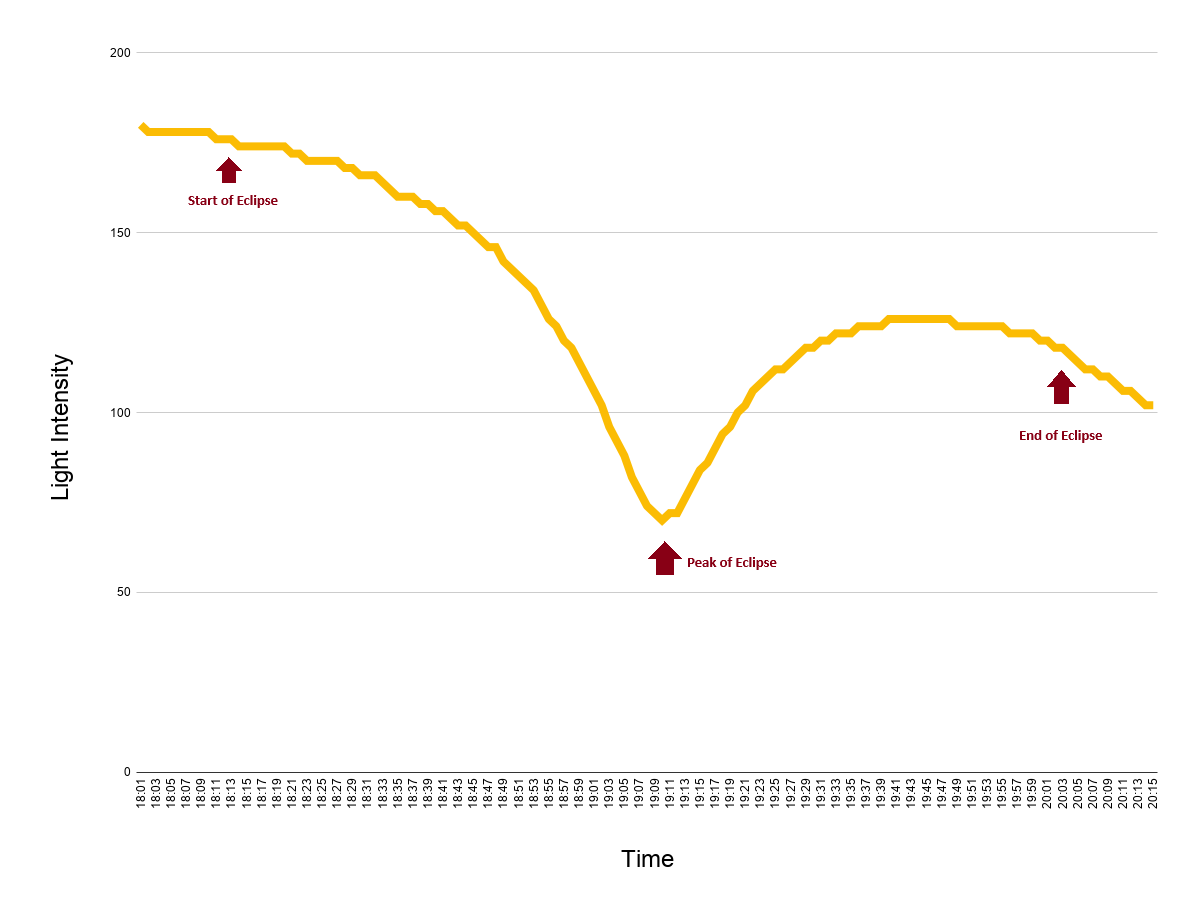
The overall background light level was already falling as the Sun got lower in the evening sky, but you can see the eclipse carved a very obvious valley into that underlying trend. The light level fell rapidly as the eclipse progressed, bottomed out, and then climbed again before resuming its overall downward trend towards sunset.
Best of all, the lowest light reading was recorded at 19:10 - lining up exactly with the peak of the eclipse.
For something measured with an uncalibrated LDR pulled from my parts bin, I couldn't have asked for a more satisfying result.
Conclusion
This was a rushed but very satisfying build, with a result that turned out better than I'd hoped. More importantly, it got me curious about how I could use other simple sensors to make visible parts of nature that we can't usually see.
I have a few ideas...