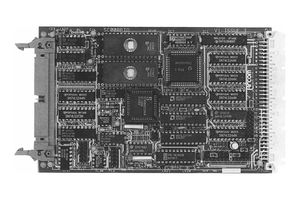
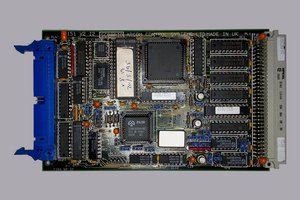
This was designed for 8052 users to access the STEbus but it did not sell well. The 8052 has no 'wait' input so it had to bit-bang the bus signals and pole the DATACK response. So it is a slow chip made even slower.
It did pave the way for the SNETM (master) and SNETS (slave) bitbus boards, but those did not sell well either, for similar reasons.
The SC52 is based around Intel's advanced 8052 microprocessor with on-chip BASIC. It can be programmed in BASIC or assembly language and programs can be stored in EPROM to create systems which autostart from powerup. The 8052 has many exciting features which include full floating-point on-chip BASIC interpreter, 3 counter-timers, full duplex UART, 256 bytes on-chip RAM, 96K addressing range and 6 interrupts.
The on-chip 8052AH BASIC is designed for process control. It is easy to use - entering a program into RAM, debugging, testing and programming it into EPROM need only take a few minutes. The BASIC has a number of features which make controlling hardware simple, including interrupt handlers in BASIC, on-chip real time clock, BCD floating point, hexadecimal arithmetic, logic operators, auto start on power-up, EPROM programming routines, memory and register settings and multiple program files in memory.
One feature especially useful in control systems is that interrupts can be handled in BASIC. This includes interrupts from external sources and from the internal real-time clock.
Developing programs on the SC52 is very easy. You can enter and edit BASIC programs using the on-board RAM. When the programs are fully tested and debugged, on-board EPROM programming hardware and software transfers then to EPROM, to create a standalone autostart system, all on one board!
Power Consumption:
typically 0.7A at 5V, 30mA at ±12V
Features:
8052AH BASIC CPU with 8K on-chip BASIC ROM
EPROM programmer for 8 and 16K EPROMs with fast programming algorithm
Up to 64K on-board EPROM
Up to 64K on-board RAM
Two RS232 ports for terminal and printer (one full duplex transmits receive, one transmit only for printer)
STEbus interface allowing the use of a massive range of STEbus I/O boards