Mike
-
Project Ceylon Development Log - October 24, 2026: Slowing Down on Purpose
6 days ago • 0 comments![]()
I'm sure there's not too many of you out there waiting with baited breath on my next words, but I do try to be consistent. It’s been a couple of weeks since I’ve done a proper Ceylon update, and the pace has changed a little.
That’s deliberate.
For a good part of this project, progress meant building things that simply didn’t exist yet: getting the machine booting, putting graphics on the screen, making storage work, building a desktop, and eventually reaching the point where an actual application could launch and do something useful.
There are enough pieces in place now that adding another new subsystem isn’t always the most useful thing I can do.
Lately I’ve been spending more time going back through the machine, fixing known problems, tightening up things that were good enough to move forward earlier, and making sure the stuff that already exists actually behaves the way I think it does.
That’s less flashy, but it’s also probably a sign that this thing is becoming a computer.
The Desktop Is Getting Less Theoretical
A lot of the recent work has been around NuGUI and the compositor—the part of the desktop responsible for deciding what gets drawn, where windows live, and who owns things like pointer and presentation behavior.
Several pieces of that work have now passed their individual checks, including pointer ownership, application-window handling, visual treatment and display-mode work.
That does not mean I’m declaring the whole desktop finished. I’m being much more careful about that distinction these days. One exact-candidate test run passed 819 tests with zero failures, and the project still correctly remained short of whole-product qualification.
Apparently “819 tests passed” and “everything works” are two different sentences.
Who knew?
NuDOS Taught Me a New Word:
gdkzNuDOS has also been getting real target testing.
One of the better bugs from the last couple of weeks came from a wonderfully simple test. We typed
ECHO, and the machine responded withgdkz.That turned out not to be some deep shell-parser catastrophe. The keyboard mapping was simply wrong for most of the alphabet.
The mapping was corrected, and some related focus/input problems were also closed out with target evidence. We also confirmed something every desktop user already knows instinctively: if you want the Terminal to receive the keyboard, you should probably give the Terminal keyboard focus first.
Again, normal computer behavior. Built the hard way.
Some NuDOS operations still report that they’re unsupported because the filesystem underneath them does not yet provide those operations. That is intentional. I would rather have the shell tell the truth than fake success because it makes a test report look nicer.
The Display Bug Was Not Where I Expected It to Be
One of the more interesting problems involved the virtual display hardware.
At first, the temptation was to fix the PCI layout directly. We tried that, discovered it was the wrong approach, and backed it out.
What eventually made the problem understandable was a controlled comparison of two otherwise similar virtual machines. Changing whether one virtual network device existed changed where the firmware placed the display device’s register window.
One device changed the memory layout of another device.
That explained why the same display assumptions worked in one QEMU profile and failed in another.
Once the measured hardware profile was represented correctly, the display-mode qualification passed. Naturally, fixing that exposed the next problem farther down the presentation path.
Operating systems are very considerate that way. They rarely let you run out of things to do.
Ceres Is Becoming a Useful Nuisance
Ceres Rock Battle has taken over the role Asteroids had earlier in development: small enough to understand, complicated enough to expose almost everything that's wrong.
Getting it into a real Ceylon image uncovered packaging and manifest problems. Getting it launched uncovered presentation problems.
One capture showed the application changing for a while and then freezing. Another capture sampled the screen so aggressively that the measurement process itself slowed the guest enough to interfere with application launch.
So yes, at one point the screenshot tool became part of the bug.
A later corrected application package stayed active and continued presenting changing frames for a much longer run. That is genuine progress, but I am still not calling Ceres qualified or reliably playable.
That distinction—between “I saw something happen” and “this is qualified behavior”—has become increasingly important as Ceylon matures.
Where Things Stand
As of November 11, Ceylon boots and runs in QEMU. The tested desktop profile can reach 1080p, keyboard input is working through the paths we’ve been exercising, Terminal and NuDOS have real target-tested functionality, applications can be selected and launched, and Ceres has reached sustained presentation in later testing.
But there is still quite a bit of work between here and Alpha evaluation.
NuGUI still needs to be completed and qualified as a whole. The desktop still needs its remaining integration work, and there are basic system utilities that need to be finished so the Alpha feels like an actual usable computer rather than a collection of successful subsystem tests.
The big remaining platform item is audio.
The audio system still has to be completed and properly tested before I’m willing to call the Alpha ready for outside evaluation. Ceylon is supposed to be a multimedia workstation, so “we’ll add sound later” isn't really an acceptable definition of the first Alpha.
Networking, clock behavior and some application-runtime work also still have open edges, and none of this should be confused with bare-metal qualification. Right now the Alpha target is QEMU.
So while we're moving in the right direction, there is still a real body of work between the current machine and something I'm ready to hand to somebody else.
That is roughly why I’ve slowed down. At this stage, fixing the problems we already know about is more valuable than opening another dozen workstreams just because I can.
What Comes Before the Alpha
The next stage is not releasing the Alpha. It is finishing the machine that the Alpha needs to be.
That means completing NuGUI and the remaining desktop integration, finishing enough of the basic system utilities to make the environment useful, getting the audio platform running and properly tested, and continuing to close the application and system issues we already know about.
Once those pieces are in place, I want to spend some time using Ceylon as a complete system rather than judging it only through separate subsystem tests. The important questions become much more ordinary: can I move naturally between applications, work with files, use the Terminal, create and save something, play media, reboot the machine and continue where I left off without discovering that two supposedly finished pieces don't actually cooperate?
That kind of testing is less glamorous than bringing up a new subsystem, but it is much closer to how somebody else will eventually experience the machine.
Then We Let Other People Break It
Once that work is complete and Ceylon reaches the Alpha readiness threshold, the plan is to give a limited QEMU Alpha to a small group for evaluation and review.
I want to collect what they find and deal with those issues before widening the audience. Once that first evaluation round is resolved, I’ll make a QEMU Alpha available for broader public testing.
That will undoubtedly produce another collection of things I didn’t think to test, because users are exceptionally good at that.
After those findings are dealt with, I’ll go back to work on the final A1 image.
There is no date attached to any of this yet.
The difference now is that I can see the path to that evaluation point much more clearly than I could a few months ago. There are still things to build, but there are fewer mysteries.
And Then Real Life Shows Up Again
Next week will probably be fairly quiet.
I have a work trip coming up, which means Ceylon is going to have to survive without quite as much attention for a few days.
Apparently the rest of my life continues to insist on participating in the schedule.
So if the development journal goes quiet again briefly, nothing has exploded.
Probably.
When I get back, the goal remains the same: keep closing known issues, finish the pieces the Alpha actually needs, and get Ceylon into a condition where handing it to somebody else feels less like an act of optimism and more like a useful engineering test.
We're not at Alpha yet.
But for the first time, the remaining work is starting to look less like “build an operating system” and more like a list of things I can actually finish.
-
Project Ceylon Development Log — October 24, 2026: Sometimes the Project Has to Wait
10/25/2026 at 04:20 • 0 comments![]()
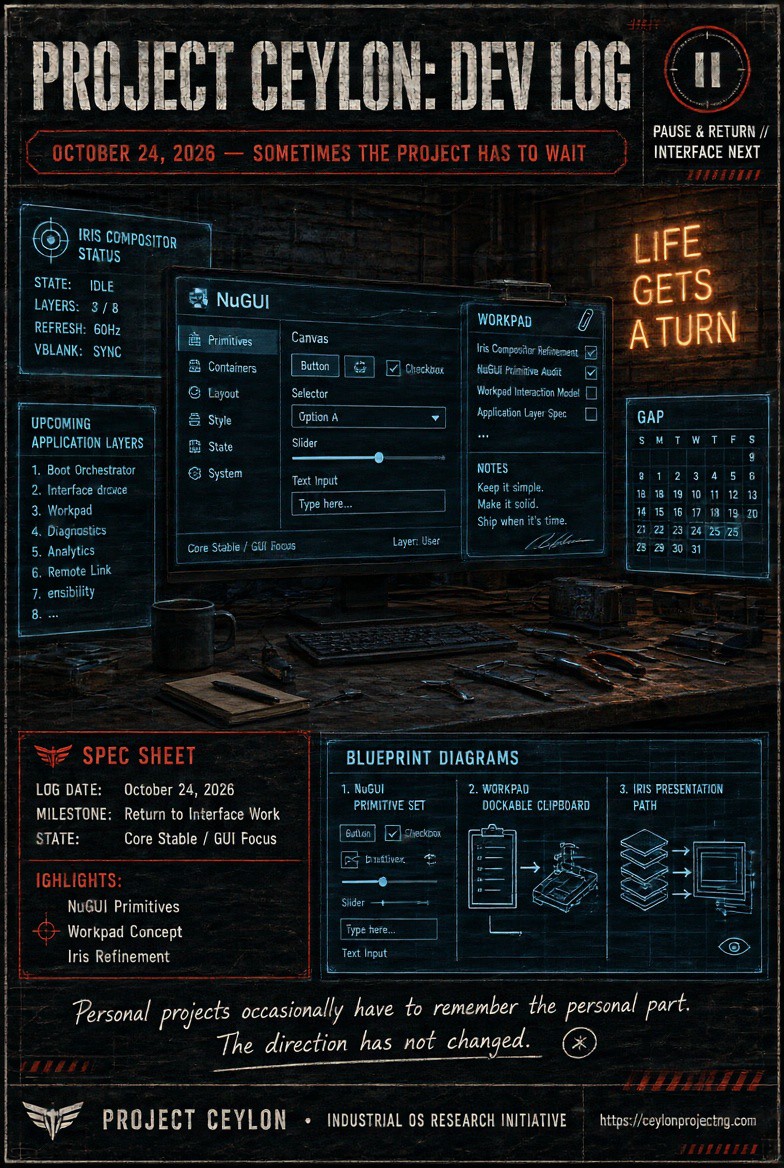
It has been quiet for about a week. Life needed the time, so Ceylon waited.
I’m picking it back up in the next few days. The foundation is in a better place than it was a few weeks ago, which means the next real work sits higher in the stack.
Next focus: the interface
The main block is NuGUI. We already have the skeleton. What it needs now is the ordinary primitive set that real applications actually depend on — controls, layout, text, panels, menus, window behavior, focus, and basic lifecycle handling. The goal is no longer “a window can appear.” It is “an application can live in this environment without constant special cases.”
Workpad is part of that. It is a visible, dockable sidecar clipboard. Not a replacement for ordinary copy/paste, just a persistent place to keep material (text, files, references) while moving between applications. For Alpha it stays deliberately modest: visible, dockable, useful. Nothing clever.
Iris needs another pass as well. The presentation path has improved, but it still carries assumptions that were acceptable when the goal was simply putting something on the screen. Those assumptions need to be cleaned up before we start expecting several real applications to share the display for extended periods.
There is also some storage and memory tightening to do. Nothing architectural — just making sure the platform’s actual behavior matches what the GUI and application layers are about to assume.
What this is aiming at
Once NuGUI, the remaining Iris work, and the audio path are in better shape, the next useful step is a small set of basic applications used together: create something in one, save it, find it in another, reopen it later, move information between tools, restart the machine, and see whether the whole thing still agrees with itself. That is the testing I want next.
Posting
I’m also dropping the near-daily log habit. The work continues, and I will keep documenting it, but I would rather write when a coherent piece of work has actually landed than force every session into its own entry. Some weeks that may mean one post. Other times it may mean combining several days into a single log that tells the story more clearly.
The direction has not changed. The next tranche is defined. I’m ready to get back to it.
-
Project Ceylon — State of the Machine, October 18, 2026
10/19/2026 at 01:10 • 0 comments![]()
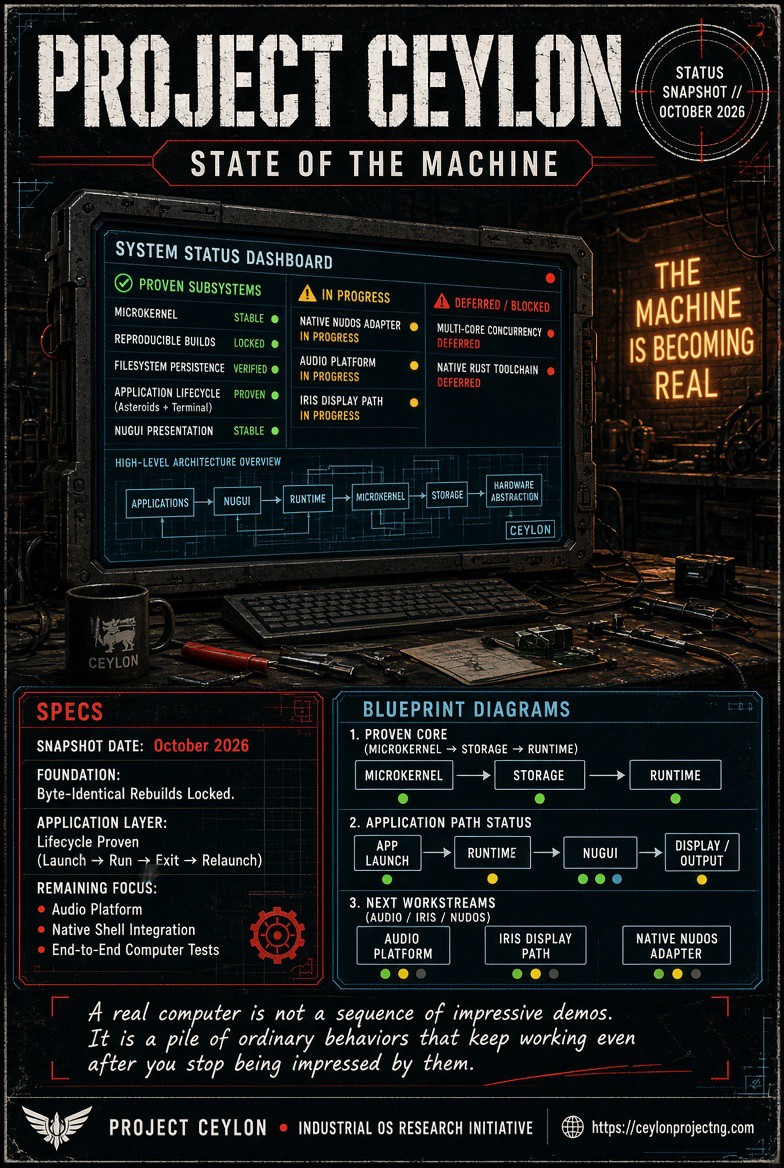
October 18, 2026Ceylon boots to a graphical desktop, accepts keyboard and mouse input, and runs native application code. Asteroids has exercised the application path, while Terminal and NuDOS now communicate through a separate shell service. Close/reopen, clipboard, and recovery scenarios have passed their defined tests.
The compositor work is integrated. Its testing covered multiple clients, presentation, application isolation, invalid requests, full queues, and recovery. Independent review also caught lifecycle defects that were repaired before acceptance. That gives us a stronger graphics foundation, although the complete NuGUI desktop is still unfinished. Audio also remains incomplete.
Storage is the immediate priority. Workpad—the window-associated tray for keeping related material—has reached explicit retention and save testing, but reliable restoration after reboot is not yet qualified. That work exposed a real invalid-write defect and gaps between a write being accepted and its contents being durably committed.
Those gaps are being addressed through filesystem coordination, journal/checkpoint work, device flush handling, and reboot controls. The latest target tests proved clock delivery, timeout handling, stale-response rejection, and several abort/retry behaviors. One final executor assertion still needs resolution. Those results do not yet establish durable Workpad recovery.
The repeated build preparation problems have also been expensive. We have corrected the input catalog, dependency provenance, preflight checks, and logging so missing ingredients are caught before another lengthy build begins.
The next goal is straightforward: finish dependable storage, complete Workpad and NuGUI, then test the integrated desktop with real applications. After that comes the broader service-boundary review and the remaining Alpha work.
There is a working machine here. The job now is making its everyday behavior dependable enough to put in other people’s hands.
-
Project Ceylon Development Log — October 13, 2026: The Bug That Wasn't There Anymore
10/14/2026 at 16:39 • 0 comments![]()
Mike · October 13, 2026
Tags: Project Ceylon, Operating Systems, Microkernel, Iris, NuGUI, Documentation, Build Systems
Today was foundation day.
Not the exciting kind. The kind where you prove the ground is actually solid before you put any weight on it.
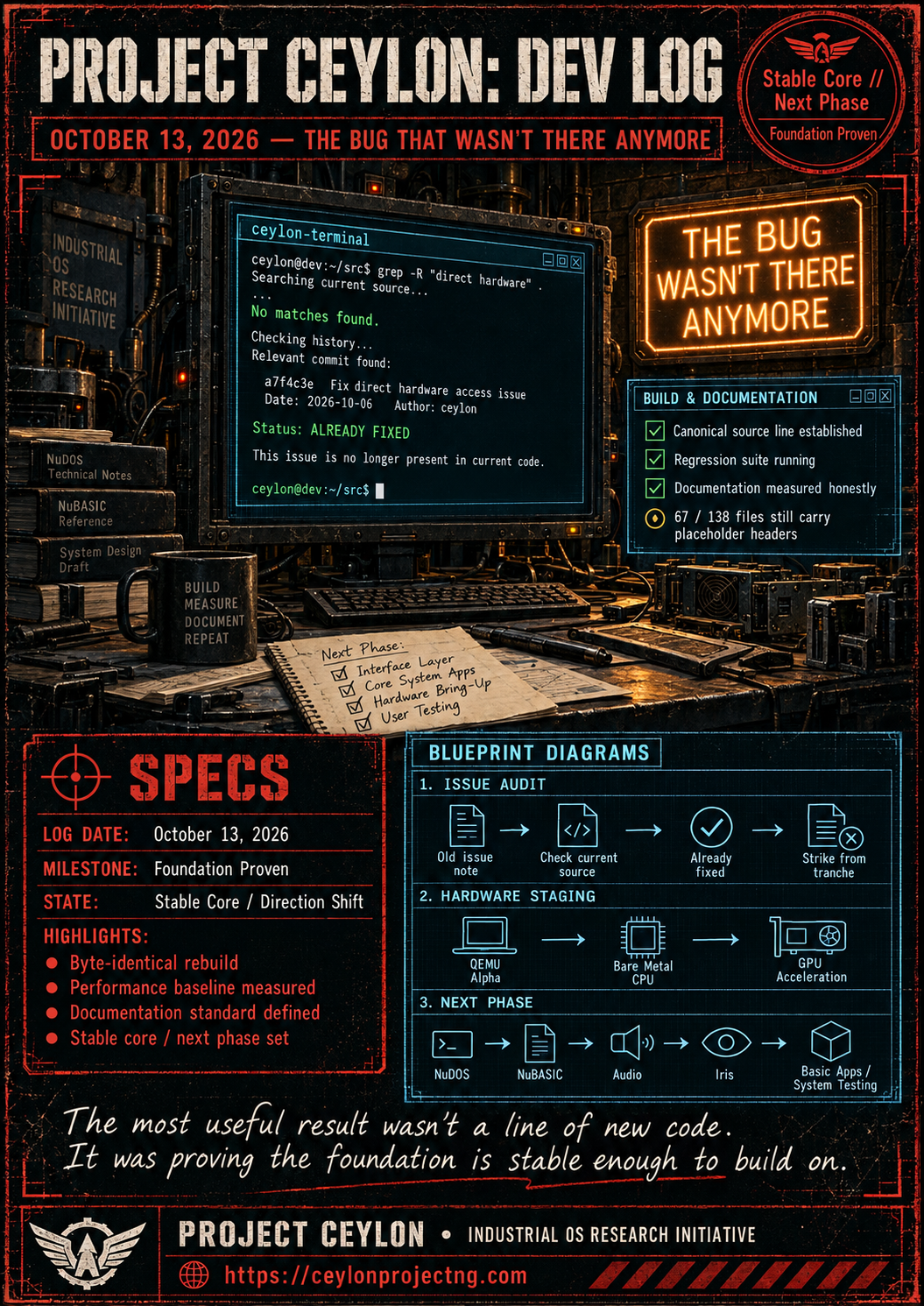
By the end of the session, Ceylon had a single canonical source line, a build that reproduces itself byte-for-byte from a clean seed, a regression suite that actually runs, and a performance baseline measured before anyone touched a single optimization.
It also had a scope document — the full Alpha release, all seven workstreams, written down and adopted.
And it had one bug that turned out not to be a bug at all, which is the part of today I actually want to write about.
Measure First, Then Build
Before any feature work, I wanted ground that wouldn't shift.
That meant a governed seed for the build, checked six different ways: provenance, completeness, three fail-closed negative tests, and a full rebuild from scratch matched hash-for-hash against the reference image.
Byte-identical.
Not "close enough."
Identical.
It also meant establishing a performance baseline before any of it got touched.
That is the part people skip. It is also the part that pays for itself immediately, because you cannot tell if something got faster later if you never wrote down how slow it was today.
We Found a Process That Had Been Running for Six and a Half Hours
While building that baseline, a verification pass flagged something that didn't belong.
A monitoring loop, left over from an earlier measurement, was still running.
Quietly.
In the background.
For six and a half hours.
Nobody noticed because it wasn't failing anything. It was just sitting there, burning CPU and skewing whatever it touched, invisible until something actually checked.
That is not a dramatic bug. It is not a design flaw. It is a background process somebody forgot to kill.
But it's exactly the kind of thing that measurement catches and assumption doesn't.
We killed it, wrote down why, and moved on.
The rule that came out of it is simple: every measurement tool gets the same guaranteed teardown as everything else. Nothing gets to just sit there because nobody was looking.
The Documentation Standard Got a Name
Heathkit kits assumed nothing.
Every step was numbered. Every step told you what you should see if it worked. The troubleshooting chart was organized by symptom, not by part number.
Ceylon's documentation now follows that same discipline on purpose, not by accident.
There's a user guide, a builder's guide, a theory-of-operation document per subsystem, and reference tables generated from the actual source rather than typed by hand — so they can't quietly drift out of sync with the code the way hand-written documentation always eventually does.
We also found out exactly how far from that standard the current source sits.
67 of 138 files still carry placeholder documentation headers.
That number is going down, not up, as each tranche touches those files.
It is not going down today.
Today was just the day we measured it honestly instead of guessing.
The Alpha Got a Shape
With the ground settled, the scope for the first public release got written down and adopted.
That includes the desktop and compositor, the DOS-style shell, the platform services underneath it, networking, audio, quality, release packaging, and documentation as its own cross-cutting workstream rather than an afterthought.
The hardware plan is staged on purpose.
The free Alpha runs under QEMU and is explicitly a proof of concept, not a performance demo.
After that comes bare-metal hardware with CPU rendering.
After that, GPU acceleration, built as a plug-in to the same contract rather than a rewrite.
The rule that makes that staging possible is simple: nothing QEMU-specific is allowed to leak into the parts of the system that bare metal will eventually replace.
That's slower to build correctly.
It's also the only way the second release doesn't become a rewrite of the first.
Then We Started Fixing Iris, and Found a Bug That Had Already Been Fixed
With the foundation in place, the first real implementation tranche went out: cleaning up the display stack, where the desktop had an old habit of reaching past the compositor and talking to the display hardware directly.
The tranche notes listed it as one of the things that still needed fixing.
It didn't.
Before touching any code, we checked the premise against the current source instead of trusting the old issue description.
The direct hardware access was already gone.
A separate remediation chain had fixed exactly that problem weeks earlier, passed its own review, and been deliberately frozen until after the Alpha ships — on purpose, so a release train doesn't keep absorbing scope forever.
Redoing that work now would have meant burning a day rebuilding something that already worked and breaking a freeze that was there for a reason.
So we didn't.
The item got struck from the tranche, and the reason got written down where the next review would actually find it.
That's the second time this week a "bug" turned out to be an outdated assumption rather than a defect in the system.
I'm starting to think that's going to be a running theme on this project, and I'm fine with that.
A wrong assumption caught before it costs you a day is a much better outcome than a bug found after it does.
We Also Said No to Something We Could Have Said Yes To
The same tranche had an item to turn on multi-core support.
The system has two cores sitting mostly idle, and at first glance there doesn't seem to be much reason not to use them.
Except there is one very good reason.
Nobody has actually proven that the shared-memory protocols between the compositor, the input path, and Iris survive losing their single-core assumption.
Right now, "nothing runs at the same time as anything else" is the entire safety argument for several pieces of code talking to each other.
That is exactly the kind of assumption that holds right up until it doesn't.
And when it breaks, it doesn't usually break as a nice clean failure while you're staring at it.
It breaks as an intermittent, nearly unreproducible bug six weeks from now.
So we skipped it.
Logged the gap, left both cores where they were, and moved on.
Turning on concurrency you haven't audited is how you trade one obvious problem for several invisible ones.
The Rest of the Tranche Was Clean
The other three items in that tranche were straightforward.
We fixed a stale configuration value, moved a hard-coded screen resolution out of a shared protocol and into actual capability negotiation, and cleaned up some leftover hot-path logging.
All three went in.
The regression suite stayed green.
The tranche closed.
That is exactly how I would like more of these to go.
Not every engineering session needs to end with a heroic rescue.
Sometimes the best result is three small fixes, one deliberate "not yet," and one item removed because somebody took the time to verify whether the problem still existed before writing code.
The Project Is Changing Gears
The bigger change today is not a single fix.
It is the direction of the project.
We now have a stable enough core that the focus can start shifting away from proving that Ceylon can exist at all and toward making it behave like a complete system.
That means the interface and the core applications start mattering more.
NuDOS.
NuBASIC.
The desktop.
Application lifecycle.
The pieces that make the machine feel like one thing instead of a collection of individually qualified subsystems.
That is where the next phase is headed.
We still have some major platform work to finish first.
Audio is not done yet, and I do not want to pretend otherwise. The shared audio path needs to be completed and qualified properly before the higher-level music applications start leaning on it.
After that, the next major job is finishing the Iris update and getting the display path where we want it.
Once those pieces are complete, we should finally be in a position to start adding a few more basic applications and use them to test Ceylon as a computer instead of testing each subsystem in isolation.
That is a different kind of testing.
It is one thing to prove the filesystem can store a file.
It is another thing to open NuBASIC, create something, save it, find it again in NuDOS, inspect it, reboot the machine, reopen it, and run it.
That is the kind of test I want next.
Not just "does this component work?"
"Does the computer work?"
Where We Ended the Day
Foundation: proven, not assumed.
We have a byte-identical rebuild, a working regression suite, and a performance baseline measured honestly before anything got optimized.
Housekeeping found one real bug — a six-and-a-half-hour orphaned process — and one real gap that isn't fixed yet and is staying on the list on purpose: there's still no off-site backup copy of any of this.
The Alpha's full scope is written down and adopted, the hardware path is staged in three deliberate steps, and the documentation now has a standard intended to keep it from quietly drifting away from the code it describes.
The first implementation tranche closed having done three things cleanly, declined to touch one thing until it's actually safe to, and discovered that a fourth item on the list had already been handled elsewhere for reasons that still hold.
More importantly, the project is starting to move into a different phase.
The core is stable.
The next focus is the interface and the core software that makes Ceylon actually feel like a system.
NuDOS and NuBASIC are part of that.
Audio still needs to be completed.
Iris still needs the rest of its update.
Once those pieces are in place, the next step is to start adding a few more basic applications and use them to put the entire machine through real end-to-end testing.
Today's biggest accomplishment might still be the same shape as yesterday's.
The most useful result wasn't a line of new code.
It was proving that the foundation is stable enough to stop spending all of our time staring at the foundation.
That's not a flashy outcome.
For where Ceylon is right now, it may be one of the most important ones we've had.
-
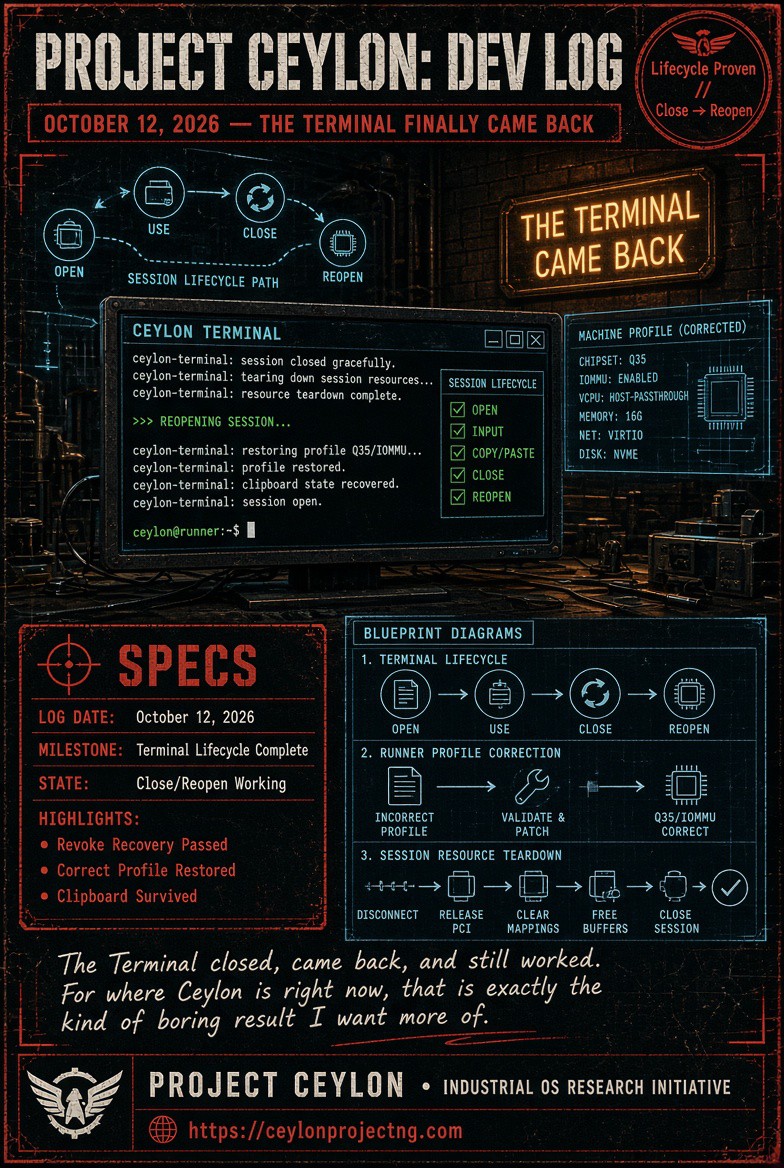
Project Ceylon Development Log — October 12, 2026: The Terminal Finally Came Back
10/14/2026 at 16:13 • 0 comments![]()
Mike · October 12, 2026
Tags: Project Ceylon, Operating Systems, NuDOS, NuGUI, Terminal, Rust, Audio, Testing, Application Lifecycle
Yesterday ended with one of those wonderfully specific operating-system problems:
The Terminal could open.
It could take input.
Copy and paste worked.
Closing it was the part that still wasn't trustworthy.
Today we pushed that path harder.
By the end of the session, NuDOS had made it through revoke recovery, real keyboard input, ordinary copy and paste, close, reopen, and the rest of the lifecycle path on the corrected machine profile.
That is a much better place to be than we were twenty-four hours ago.
It also came with a useful reminder that not every failure belongs to the product.
Sometimes the test rig is the thing lying to you.
We Found the "Bug" in the Runner
One of the remaining NuDOS failures looked like a post-revoke keyboard problem.
That was concerning because revoke/recovery behavior is exactly the sort of thing we are trying to prove before calling the desktop environment stable.
The eventual root cause was not a production input defect.
The qualification run had been using the wrong machine profile.
Once the intended Q35/IOMMU/xHCI configuration was restored, the supposedly broken recovery path behaved correctly.
Keyboard input after revoke passed.
Ordinary copy and paste passed.
Closing the Terminal passed.
Opening it again passed.
The session lifecycle passed.
That result matters for more than just the Terminal.
We have spent a lot of time lately making sure Ceylon's qualification process distinguishes between "the system failed" and "we did not actually test the system we thought we were testing."
Those are very different conclusions.
A bad runner configuration can waste hours if you trust the first screaming subsystem and start repairing it.
So today was another case where the most useful debugging result was figuring out which layer was actually guilty.
NuDOS Is Getting Close to the Interesting Part
The NuDOS work has now moved well beyond "does the parser understand a command?"
We have already been through command semantics, malformed input, clipboard behavior, application/session interaction, saturation, cancellation, revoke behavior, and recovery.
Now the important paths are increasingly the ones that make the shell feel like part of the operating system rather than a library with a prompt attached to it.
That means the Terminal has to survive the same lifecycle expectations as any other application.
It has to open through the normal desktop path, interact with the system services it is entitled to use, shut down cleanly, give its resources back, and start again without inheriting stale state from the previous session.
Today's R32 work proved that sequence on the corrected test configuration.
That is significant.
It is not the same thing as saying NuDOS is finished.
There are still open qualification items, the final native adapter is not complete, and the full target session remains ahead.
But the remaining problem set is getting smaller and much less mysterious.
That is exactly where I wanted to get before integration work starts becoming expensive.
The Audio Work Also Reached a Useful Boundary
Audio continued moving in parallel, but under a very deliberate rule:
do not let audio experimentation interfere with the NuDOS qualification work.
The current audio prebuild has now reached a useful host-side checkpoint.
The code compiles on the host.
The host tests pass.
The reference audio fixture passes.
That includes the basic 48 kHz stereo path we wanted for the first round of validation.
What did not happen today is just as important.
We did not prove native Ceylon audio.
The target-side build hit an offline toolchain dependency around the Rust build-standard-library path.
The Aria/Lyra source reconciliation is still incomplete.
Native HDA output was not run.
Nothing was promoted into the canonical system image.
That means the right status is:
the prebuild is host-qualified, not target-qualified.
That wording may sound excessively careful.
It is not.
Audio is one of the easiest areas in the project to accidentally overstate because producing samples in a host test is a very different achievement from moving real-time audio through Ceylon's native graph, provider boundary, timing model, and hardware output path.
So we are keeping those claims separate.
Audio Is Also Being Kept in Its Own Sandbox
We tightened the work discipline around that effort today too.
The audio work is isolated from the active NuDOS qualification environment.
Separate worktree.
Separate outputs.
Separate toolchain state.
Separate disks and runtime resources where needed.
And no audio QEMU run if there is any chance it could disturb the NuDOS evidence session.
That sounds like project-management trivia until two experiments accidentally share a disk image or one validation run modifies the state another one was supposed to prove.
Then it stops being trivia very quickly.
The general rule is becoming familiar:
if two pieces of work can contaminate each other's evidence, they should not be sharing the same sandbox.
Rust on Ceylon Still Starts Smaller Than rustc
We also continued tightening the native-Rust plan.
Yesterday's audit made the current position fairly clear.
Ceylon already uses Rust extensively, but it does not yet provide the general-purpose environment that a native Rust compiler and Cargo expect.
So the immediate target is not "port rustc."
It is much smaller.
First, prove one ordinary application-shaped Rust payload through the real Ceylon runtime.
Then prove a second one that uses bounded allocation.
Make sure both can be loaded, run, fail in controlled ways, clean up, and relaunch.
That will tell us much more about the application ABI than prematurely attacking LLVM, Cargo, build scripts, procedural macros, and the rest of the modern Rust ecosystem.
The larger native-development goal has not changed.
Eventually I want Rust running on Ceylon itself.
I want the machine to be able to build software without treating Linux as a permanent umbilical cord.
But there is a sensible order to that work.
First the machine needs to be a stable application host.
Then it can become a development host.
We Also Built More of the Future DAW Than I Expected
There was some application-side audio work today as well.
The portable mixer core for the future DAW has been pushed substantially farther than a mockup.
The current design starts with 25 channels and can expand beyond that as needed.
Routing, sends, undo behavior, channel banking, save/load behavior, and PCM mixing have all been exercised in the portable implementation.
That is useful groundwork.
It is not a native DAW yet.
There is no finished Ceylon GUI integration, native audio connection, sequencing environment, or plugin host wired into it.
So, again, the distinction matters.
We are building and testing the reusable logic now so that when the native application layer is ready, we are not inventing mixer behavior and operating-system integration at the same time.
That is the same pattern we have been using with NuDOS and increasingly with the rest of the application work.
Define the behavior.
Build the portable core.
Attack it with tests.
Then attach it to Ceylon.
One unknown at a time is enough.
The Machine Is Getting Less Forgiving
One thing I am noticing as Ceylon gets farther along is that the tests are getting meaner.
Early in the project, a successful boot could make the whole day.
Then a visible framebuffer was exciting.
Then input.
Then applications.
Now an application opening is not enough.
It has to close.
Then reopen.
Then survive revoke.
Then recover input.
Then prove it did not inherit stale state.
Then do it on the correct machine definition.
The bar keeps moving.
That is a good thing.
A real computer is not a sequence of impressive demos.
It is a pile of ordinary behaviors that keep working even after you stop being impressed by them.
NuDOS being able to reopen after a close is not a flashy screenshot.
Neither is deterministic clipboard recovery.
Neither is discovering that the test runner had the wrong hardware profile.
But those are exactly the kinds of things that separate "we got it to work" from "this might actually be dependable."
Where We Ended the Day
NuDOS had a productive day.
The post-revoke keyboard issue was traced to a runner/profile mismatch rather than a production input defect.
With the correct QEMU profile in place, keyboard recovery, ordinary copy and paste, close/reopen, and the session lifecycle all passed.
There are still open qualification items, and the final native adapter and complete target session are not done.
Audio reached a solid host-side prebuild checkpoint, but native target compilation remains blocked by the offline Rust standard-library build dependency, and native HDA playback has not been proven.
The audio work is now isolated so it cannot contaminate NuDOS qualification.
The native-Rust plan is getting smaller and more realistic: prove ordinary application payloads first, then grow toward the compiler instead of beginning with it.
And the future DAW now has a much more substantial portable mixer core waiting for the native platform to catch up.
So today's biggest accomplishment may sound almost comically ordinary:
the Terminal closed, came back, and still worked.
For where Ceylon is right now, that is exactly the kind of boring result I want more of.
Convert to PDF
-
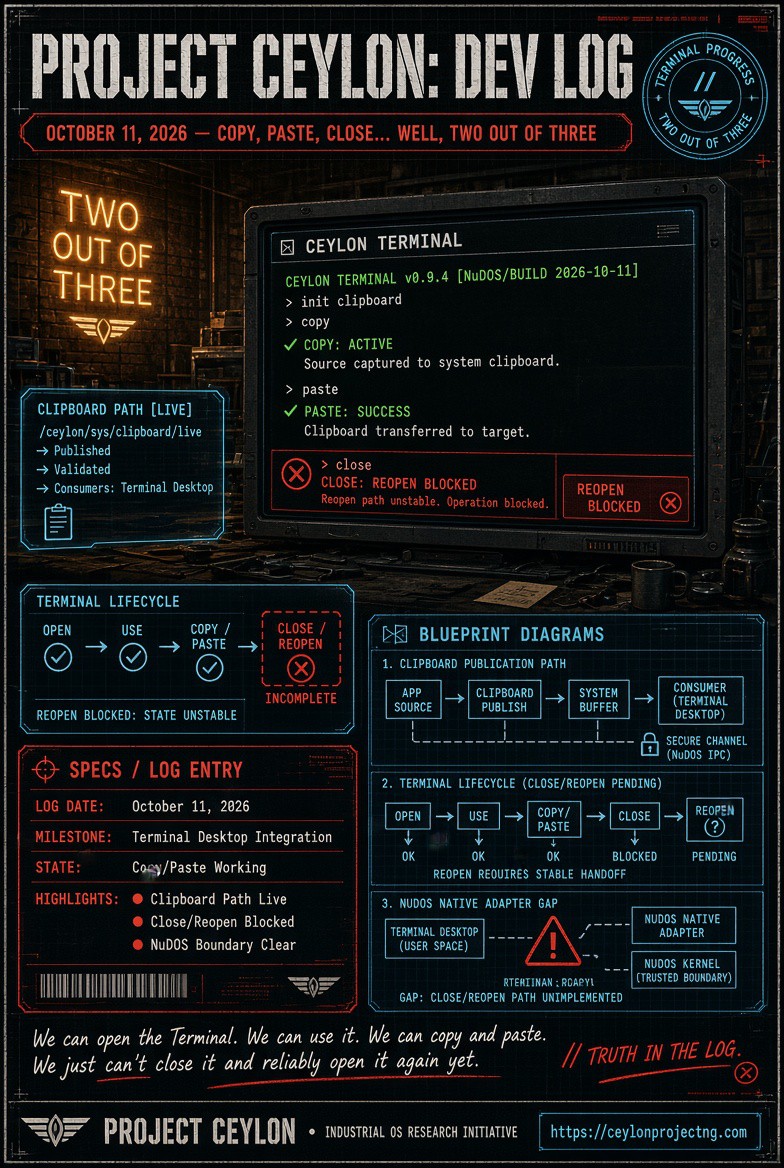
Project Ceylon Development Log — October 11, 2026: Copy, Paste, Close… Well, Two Out of Three
10/14/2026 at 16:04 • 0 comments![]()
Mike · October 11, 2026
Tags: Project Ceylon, Operating Systems, NuDOS, Terminal, Rust, Audio, Compilers, Application Runtime, Testing
Yesterday was one of those satisfying operating-system days where Asteroids finally started behaving less like a test payload and more like an application.
Today was more shell-shaped.
NuDOS continued moving toward the real Ceylon desktop, and by the end of the day we had ordinary copy and paste working through the intended path, the input regressions were still green, and the next failure had become wonderfully specific:
we can open the Terminal. We can use it. We can copy and paste. We just can't close it and reliably open it again yet.
Honestly, I'll take that.
That is considerably better than "something somewhere doesn't work."
NuDOS Is Starting to Meet the Rest of the Computer
The portable NuDOS command engine has been coming together for a while, but the interesting work now is increasingly at the boundary between that engine and the actual Ceylon desktop.
That means the boring-but-important stuff.
Input has to arrive through the real semantic-input path. Output has to travel through the correct Terminal/session plumbing. Clipboard operations have to behave like desktop operations rather than test-harness tricks. Closing the Terminal has to tear down the application cleanly enough that the operating system can create another one afterward.
Today the copy/publication path passed.
Paste passed.
The existing HID/input behavior survived the changes.
That gives us another useful slice of normal desktop behavior rather than a synthetic test case.
The Terminal can receive the user's input, interact with the clipboard, and continue through the normal application path without regressing the input work underneath it.
The current problem is lifecycle.
Closing the Terminal and bringing it back is still blocked.
That is now the thing we are chasing.
"Close the Window" Is Still Not a Small Request
Yesterday Asteroids gave us a similar lesson.
Running an application is one problem.
Stopping one correctly is another.
Stopping it and then proving the operating system can reuse everything afterward is where the lifecycle starts becoming interesting.
The same applies to the Terminal.
When the user closes it, several things have to agree about what just happened. The GUI has to issue the right close request. The application has to receive it through the supported lifecycle path. Its session attachments need to be retired correctly. Resources need to be returned. Stale state must stop being useful. Then a new Terminal instance has to start without inheriting pieces of the old one.
If any one of those steps is incomplete, "close the window" becomes "close the window and discover an operating-system archaeology project."
That is roughly where we are.
The useful part is that the failure has moved toward the normal NuGUI close ingress rather than remaining some vague Terminal problem.
So the next qualification pass is focused on that path: get the normal close operation through teardown, prove reopen, and then repeat the cycle enough times to make sure we have not merely gotten lucky once.
Until that works, I am not calling the Terminal lifecycle finished.
The Native NuDOS Adapter Still Has Work Left
There is another distinction worth keeping clear.
NuDOS itself now has substantial portable implementation behind it.
That does not mean the complete native Ceylon NuDOS environment is finished.
The final native adapter is still not qualified, and the full target session has not yet been run end-to-end.
That distinction matters because I do not want to repeat one of the project's recurring bad habits: proving ninety percent of a path and then mentally promoting it to one hundred.
The command engine can be good.
The Terminal can be good.
The session transport can be good.
The clipboard can be good.
And we can still be missing the one piece that makes them behave like one coherent shell environment.
So we are continuing to close that gap instead of declaring NuDOS "done" because the screenshots would look convincing.
We Also Took a Harder Look at Rust
Today's research also came back around to the question of native development on Ceylon.
We have been talking about eventually putting Rust on the machine itself rather than permanently compiling Ceylon software in Linux and transferring the resulting binaries over.
Today we did a more disciplined audit of what Rust support actually exists right now.
The answer is useful precisely because it is not magical.
Ceylon already contains a fair amount of Rust code, but today's target-side Rust environment is primarily a small, freestanding,
no_stdworld built for the microkernel environment.That is very different from saying:
Ceylon has Rust.
There is no native
rustcrunning inside Ceylon today.There is no native Cargo environment.
There is no general Rust standard library for ordinary applications.
There is no general-purpose process model, dynamic loader, shared-library system, TLS runtime, or broad threaded application environment waiting around for Cargo to use.
The current application-runtime work is also intentionally bounded and much smaller than what a modern compiler toolchain expects.
So the compiler question has become much more concrete.
A Compiler Is an Application That Needs an Operating System
It is tempting to think of porting Rust as:
compile
rustcfor Ceylon, copy it over, done.That would be lovely.
Rust has other plans.
A useful native compiler needs a surprisingly large amount of ordinary-computer infrastructure underneath it. It needs serious writable storage. It needs files and directories with useful semantics. It needs to create output files, launch tools, manage memory, report diagnostics, and eventually deal with build scripts, procedural macros, synchronization, environment state, and all the other things development tools quietly assume an operating system already solved.
Cargo expands that problem considerably.
That does not make native Rust a bad goal.
It means we need to approach it in stages.
The sensible first experiment is much smaller: qualify one ordinary Rust application payload through Ceylon's real application path, first using only
core, then with a small bounded allocation workload.Prove that the application builds, packages, loads, runs, exits, cleans up, and relaunches correctly.
Then start expanding what "Rust application" means.
That is a much healthier path than starting by trying to drag the entire Rust toolchain onto a system whose application ABI is still settling.
Eventually, though, I still want the compiler on the machine.
Ceylon is supposed to become a real computer.
Real computers should eventually be able to build their own software.
C++ Came Up Too
We also spent some time looking at C++ compiler options.
The recently open-sourced EDG C++ frontend is particularly interesting because EDG has been around forever and sits underneath a surprising amount of serious commercial compiler technology.
That does not mean we picked it.
It does not mean Ceylon suddenly has a C++ compiler.
It means it joined the research pile.
The same standard applies there as with Rust: I am interested in tools that can eventually run on Ceylon, not merely tools that can cross-compile something on Linux and hand Ceylon the result.
Cross-development is useful.
Permanent dependence on the cross-development host is not the destination.
For now, C++ stays on the back burner while we figure out which compiler architecture would actually fit the system cleanly.
Audio Is Getting the Same "Build the Foundation First" Treatment
Audio also got some attention today.
The temptation there is obvious because we have already been talking about the Synth, Sequencer, DAW, native instruments, VST support, and the grand-piano work.
The correct starting point is none of those applications.
The correct starting point is the shared audio platform underneath them.
So we spent time tightening the baseline for Aria, Lyra, the audio-provider layer, timing, event transport, bounded audio buffers, plugin isolation, latency accounting, fault handling, and the eventual HDA output path.
The architectural rule is simple:
build and qualify the audio system first; let the applications consume it later.
I do not want three future music applications to each quietly invent their own audio engine because we were impatient.
The first Rust audio prebuild work has also begun in a self-contained form. That work is still host-side preparation and qualification. It is not evidence that native Ceylon audio output is working yet.
The actual target path still has to be reconciled with the live Aria/Lyra implementation, the device/provider boundary, and real output hardware behavior.
Same lesson.
Different subsystem.
There Is a Theme Here Somewhere
Most of today's work came down to separating things that sound similar but are not actually the same claim.
NuDOS has a command engine.
That is not the same as saying NuDOS is fully integrated.
Ceylon is largely written in Rust.
That is not the same as saying Ceylon can run a Rust compiler.
We have audio architecture.
That is not the same as saying the machine can play qualified native audio.
We can close some applications.
That is not the same as saying every application lifecycle path is reusable and correct.
This may be the least glamorous skill I have learned during this project:
be annoyingly specific about what has actually been proven.
It slows down triumphant declarations.
It also reduces the number of triumphant declarations I have to retract later.
I consider that a fair trade.
Where We Ended the Day
NuDOS made meaningful progress today.
Normal copy and paste are working through the intended path, and the HID/input regression remains clean.
The next real blocker is Terminal close/reopen behavior. That is getting a focused lifecycle pass rather than being worked around.
The final native NuDOS adapter and full target session are still ahead of us, so there is no promotion victory lap yet.
On the tooling side, we now have a much clearer picture of what Rust on Ceylon actually means. The current Rust environment is useful but intentionally small. Native
rustcand Cargo remain future work, and the first sensible step is a much smaller ordinary-application qualification rather than trying to swallow the complete toolchain at once.C++ compiler research remains research.
Audio is being pushed toward a shared platform baseline before the DAW, Sequencer, and Synth are allowed to invent anything underneath themselves.
And tomorrow?
Probably more Terminal lifecycle work.
Which means there is a very real chance tomorrow's major operating-system milestone will be:
we closed a window and opened it again.
I'm not even joking.
At this point, I'd be delighted.
-
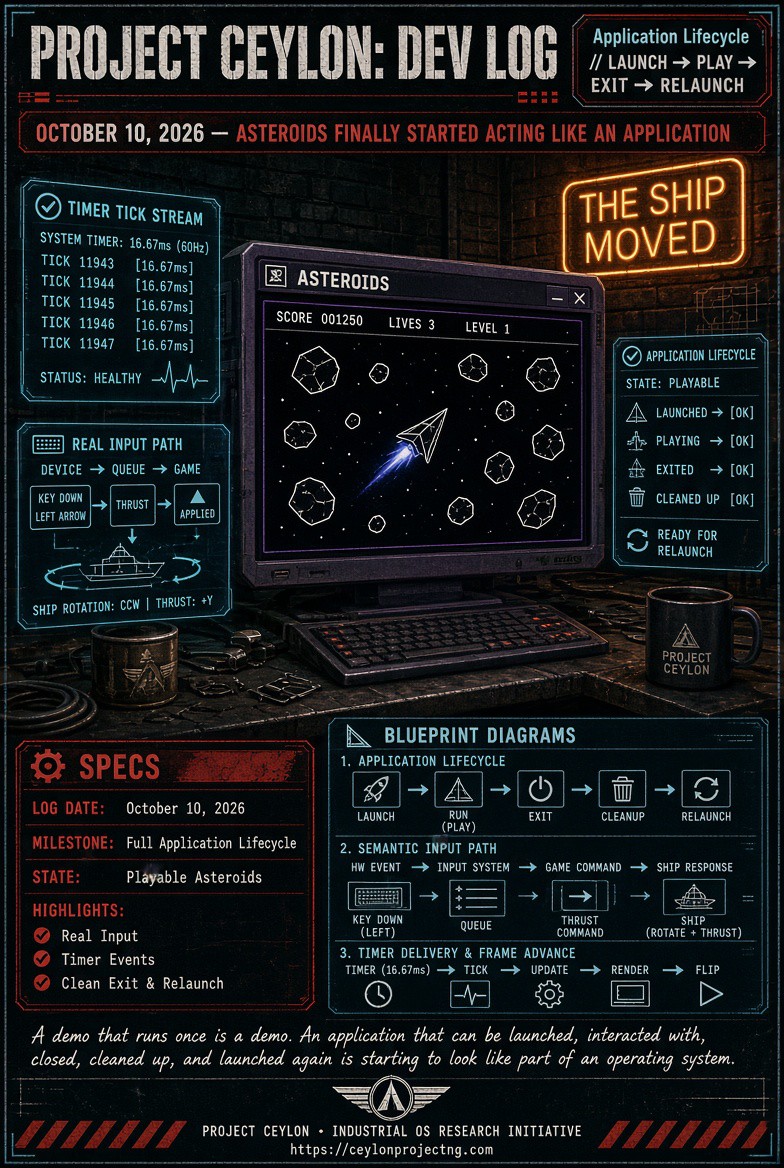
Project Ceylon Development Log — October 10, 2026: Asteroids Finally Started Acting Like an Application
10/11/2026 at 06:54 • 0 comments![]()
Mike · October 10, 2026
Tags: Project Ceylon, Operating Systems, NuGUI, Nu-Iris, Asteroids, NuDOS, Rust, Application Runtime, Testing
There are certain milestones in an operating-system project that look completely unimpressive if you describe them badly.
Today we got one of them.
Asteroids launched.
It accepted real keyboard input.
The ship actually responded to it.
It kept receiving timer events and drawing frames.
Escape caused the application to exit.
Its resources were cleaned up.
The desktop came back.
Then we launched it again.
That last part may be the most important.
A demo that runs once is a demo.
An application that can be launched, interacted with, closed, cleaned up, and launched again is starting to look like part of an operating system.
Today Ceylon got considerably closer to that second category.
The Timer Was Lying in Wait
We started the day chasing a timer race.
Asteroids had already reached the point where it could get far enough into the application path to expose problems that simpler tests were not finding.
One of those was in the timing path.
The application could register for timer events, but there was a race between registration and the point where the application actually began waiting for them. Under the wrong ordering, the event could arrive at exactly the wrong moment and the application would sit there waiting for something that had, technically, already happened.
Those are always fun.
The repair was small in terms of code, but important in terms of behavior. The clock path was corrected, the governed build passed, repeated timer events arrived, and Asteroids made it through another frame and back through the normal NuGUI/Nu-Iris presentation path.
No timer fault.
No panic.
No shortcut around the application architecture.
That got us past one obstruction.
Then input found the next one.
Input Was Connected, But Not Quite Alive
The semantic-input path had its own problem.
The application input page was being reset in a way that also erased the ABI identification fields that told the receiving side what the page actually was.
So the transport existed.
The application existed.
The data path existed.
And we had managed to wipe the sign off the front door.
That was repaired by restoring the input-page ABI magic and version correctly during reset.
After that, the real HID path made it all the way through NuGUI focus handling and into the application.
Not injected test input.
Not a host-side simulation.
Real input from the machine.
The first useful proof was simple: Left and thrust events reached Asteroids.
That was enough to show the path was connected.
It was not yet enough to say the game was playable.
So we kept going.
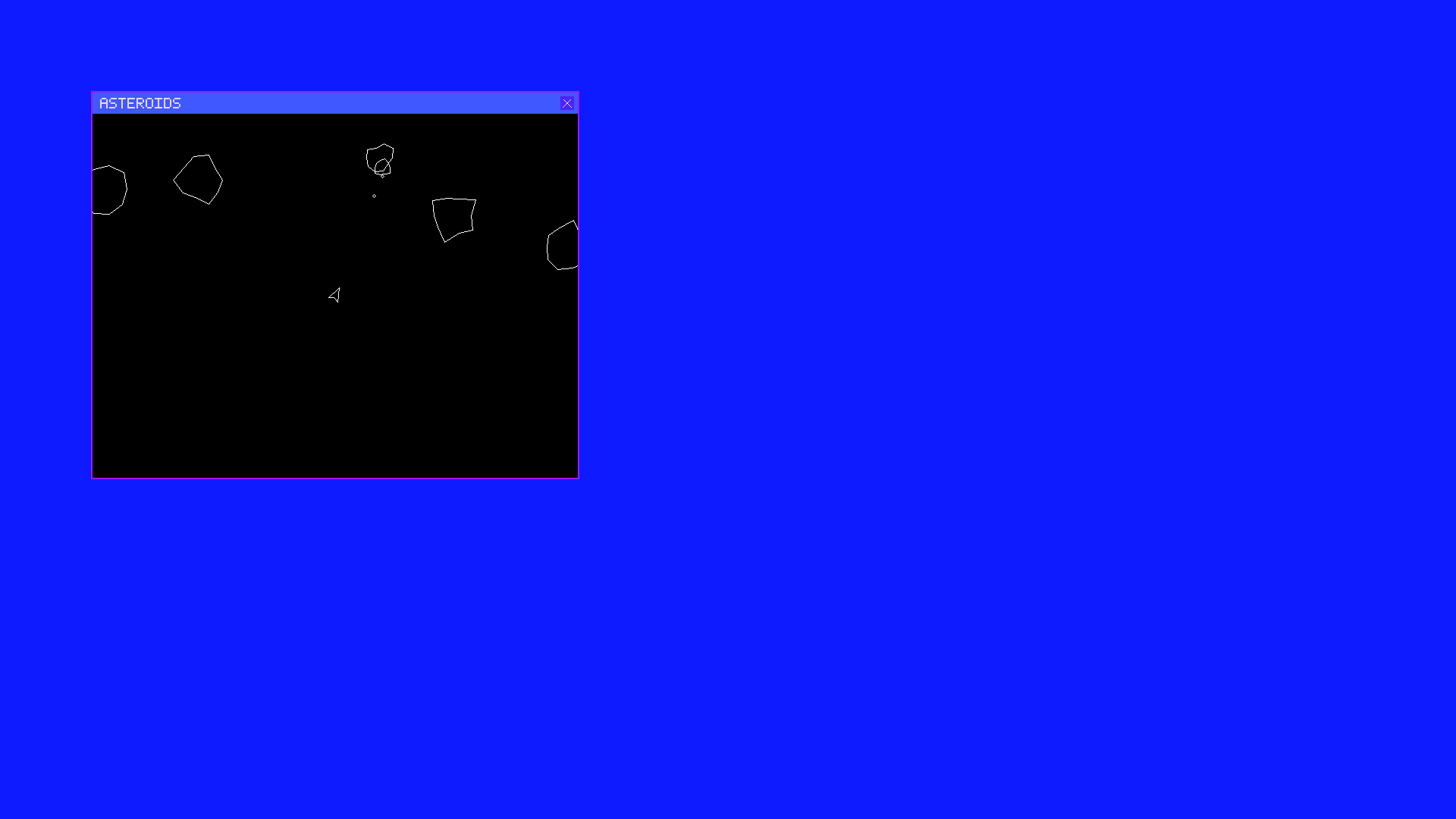
Then the Ship Actually Moved
![]()
![]()
The next qualification pass exercised the normal game state rather than merely checking whether an input event appeared somewhere.
Rotation affected the aircraft—well, spacecraft.
Thrust affected movement.
The timer continued to advance the simulation.
Rendering continued.
Presentation continued.
The existing Asteroids tests, platform-core tests, and clock tests all remained green.
At that point, the application was responding to real Ceylon input and advancing through the real runtime path.
There was one important qualification attached to that result:
we were running QEMU without a visible display for that particular test.
So we proved gameplay state and the presentation chain operationally, but we did not pretend that meant a human had stood there and visually verified every rendered frame.
That distinction has become almost a reflex around here.
I consider that progress too.
Closing an Application Turns Out to Be an Operating-System Feature
Once Asteroids could run, the next question became:
what happens when the user is finished with it?
That sounds trivial if you are used to an operating system that already has thirty years of application-lifecycle machinery underneath the close button.
We are currently building that machinery.
Escape was wired into the application lifecycle so the game could request a clean exit. The timer had to stop. Application-owned resources had to be released. The slot had to return to a reusable state. NuGUI had to recover the desktop correctly.
Then the important test:
launch it again.
That worked.
So today we got a full little application lifecycle:
launch, run, receive input, update, render, exit, clean up, return to desktop, relaunch.
That is a much more interesting result than "Asteroids boots."
It means Ceylon is starting to understand the difference between running some code and hosting an application.
NuGUI Got a Little Less Blue in the Process
There was also a much more visible NuGUI repair today.
Some framebuffer color values were being packed incorrectly, so the intended theme colors were not reaching the display the way they were supposed to.
That got corrected by bringing the framebuffer packing into line with the shared theme-color definitions.
The result is the slate-colored desktop we actually intended rather than one produced by accidentally rearranging color channels.
That change then had to survive the same basic question everything else does now:
did fixing the desktop break Asteroids?
It did not.
That may not sound profound, but I am becoming very fond of changes that fix one thing without setting fire to something three directories away.
Application Lifecycle Still Has One Sharp Edge
The newer close-request path also received more testing.
The current lifecycle revision can handle the newer application path: pointer-driven close requests, cleanup, and relaunch all worked.
But compatibility testing against the older Asteroids application interface exposed a fault in the resident execution path.
The useful part is that we did not lose the entire afternoon guessing.
The fault was narrowed to an indirect timer-wait call occurring right at the stack boundary.
The application image itself had not changed.
Its package had not changed.
There was no evidence of code/data overlap.
The next step is therefore much more specific: measure the resident-path stack high-water behavior and determine whether the compatibility path simply does not have enough stack for what it is being asked to do.
That remains open.
And that is exactly how I want to report it.
The new lifecycle works.
Compatibility with the previous interface is not yet proven.
Both statements can be true at the same time.
NuDOS Has Started Becoming Code
Asteroids was not the only application-side work today.
NuDOS also crossed an important boundary.
For quite a while, most of the recent NuDOS work has been specification work: figuring out what the shell actually owns, how commands should behave, what belongs to the filesystem or session services, how cancellation works, what happens around restart, and how we avoid inventing POSIX just because command lines are involved.
Today that started turning into an actual portable Rust command engine.
The current work is still deliberately below the final Ceylon integration layer. It is the reusable command core that will eventually sit behind the native Terminal and session bindings.
That core is already being attacked with the kinds of cases we spent so much time specifying: malformed input, stale responses, cancellation races, short writes, backpressure, Unicode handling, traversal attempts, and persistence behavior.
The test suite reached 44 cases.
That does not mean NuDOS is running natively in Ceylon yet.
It isn't.
The final native adapter and integration path still have to be connected and qualified against the application lifecycle work that is settling underneath it.
But there is now considerably less distance between "NuDOS specification" and "NuDOS implementation."
Eventually, Ceylon Needs to Build Its Own Software
That led into another discussion tonight about Rust.
Right now, the Rust code that becomes part of Ceylon is built using the external Linux/container toolchain and then placed into the system.
That is fine for building an operating system.
It is not where I want Ceylon to remain forever.
Eventually, Ceylon should be able to host its own Rust compiler, linker, Cargo environment, and supporting libraries.
Not "run the compiler on Linux and copy the binary over."
Actually compile software on Ceylon.
That is a much larger problem than simply moving
rustcinto a directory and hoping for the best. A compiler expects a useful filesystem, memory allocation, process or job execution, console I/O, synchronization, persistent storage, executable loading, and a fairly substantial collection of runtime facilities.We are not starting that port tonight.
This was research and planning.
But it matters because Ceylon is supposed to grow into a real computer, not remain permanently dependent on the machine that built it.
At some point, Pinocchio has to build his own toys.
This Was a Pretty Good Day
The interesting thing about today is that none of the individual pieces sounds enormous.
A timer race got fixed.
An input-page reset got fixed.
Asteroids responded to controls.
Escape worked.
The desktop came back.
The game relaunched.
A color-packing bug got corrected.
A compatibility fault got narrowed down instead of hand-waved away.
NuDOS gained a real command-engine implementation.
And we started putting more concrete boundaries around the eventual goal of native Rust development.
Taken together, though, Ceylon looks a little different tonight than it did this morning.
Asteroids is no longer merely proof that we can execute application code.
It is becoming proof that Ceylon can host an application through a lifecycle.
NuDOS is no longer purely a specification exercise.
And the development-tool discussion is beginning to look beyond cross-compilation toward the day when the machine can participate in building itself.
There is still plenty to qualify.
Audio remains its own problem.
The legacy application-lifecycle path still has a stack issue to resolve.
NuDOS still needs its native binding.
And nobody should mistake a productive day for a finished Alpha.
But today the machine launched a game, let us control it, let us quit it, cleaned up after it, and let us start it again.
For a system that not very long ago was celebrating pixels appearing at all, I'll take that.
-
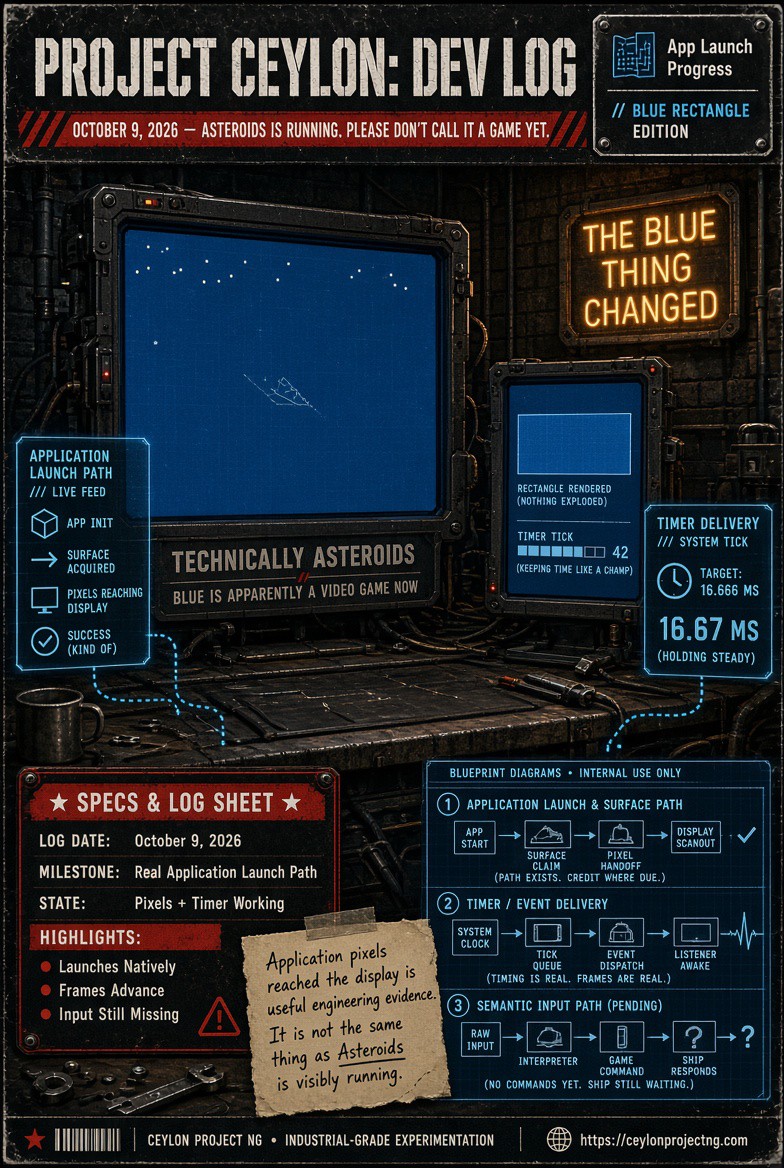
Project Ceylon Development Log — October 9, 2026: Asteroids Is Running. Please Don’t Call It a Game Yet.
10/10/2026 at 07:56 • 0 comments![]()
Today was not a dramatic Ceylon day.
It was a slow, sleepy, stare-at-the-same-log-for-too-long kind of day.
Most of it was spent trying to get Asteroids across the line from:
“there is application code in the machine”
to:
“I can actually sit down and play Asteroids.”
We are not there yet.
But we're considerably closer than we were yesterday.
The Good News: It Actually Launches
The application path made real progress.
Asteroids can now make it through the normal Ceylon machinery far enough to enter its native application code, get a drawing surface, and push application pixels through NuGUI and Nu-Iris toward the display.
That's important because this is no longer a fake built-in demo or some special test program living outside the normal application model.
We're trying to make the game behave like an actual Ceylon application.
Application exists.
Desktop discovers it.
User launches it.
Application gets an isolated runtime slot.
Application gets a window/surface.
Application draws.
That much is becoming real.
The Bad News: Blue Is Apparently a Video Game Now
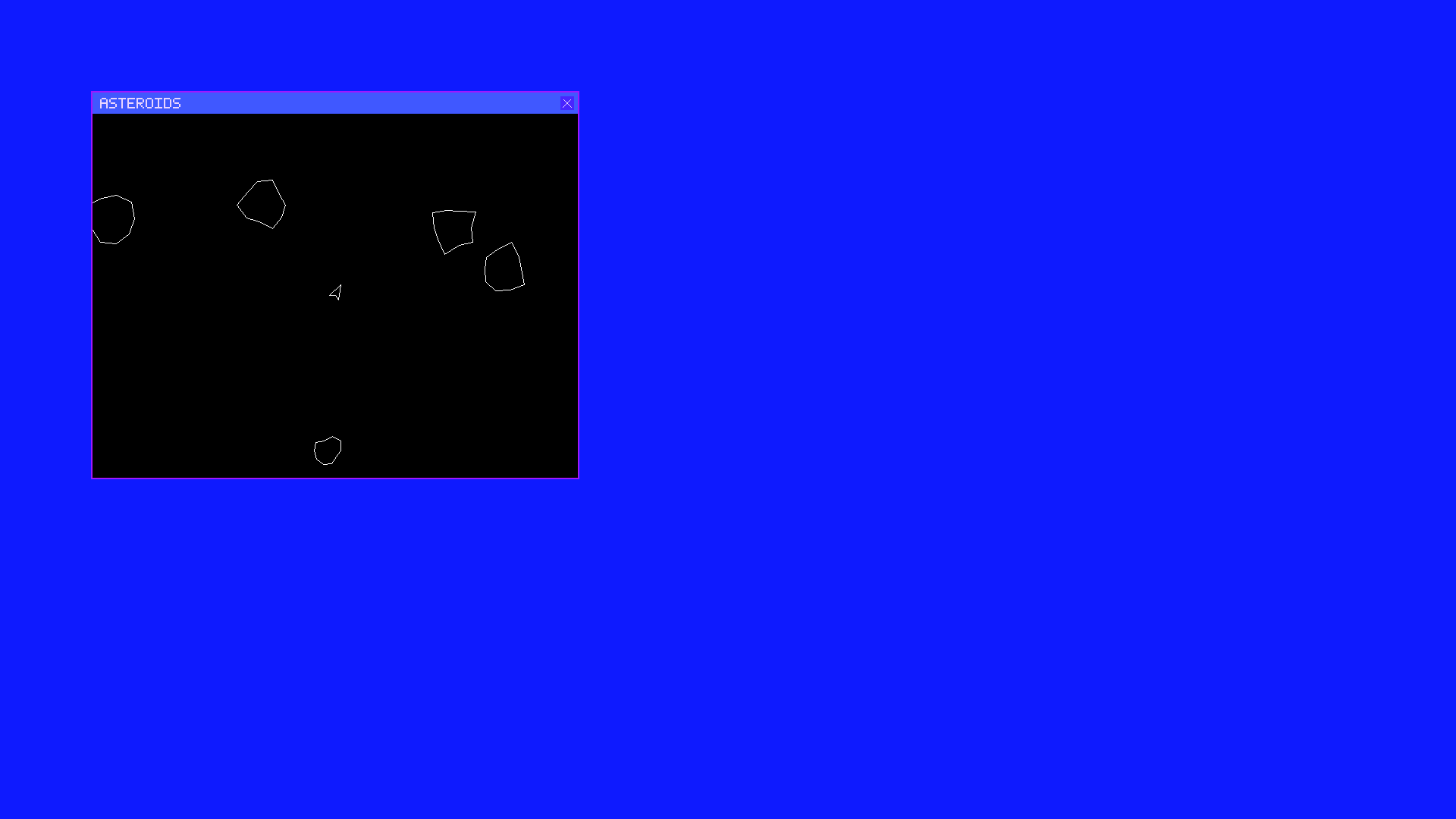
At one point we had a screenshot that, according to the instrumentation, contained Asteroids output.
I looked at it.
![]()
It was blue.
Mostly blue.
There were a few tiny white points hiding in there if you were feeling charitable.
Technically, those pixels had traveled through the right machinery.
Technically, the application had produced output.
Technically, I suppose this was progress.
Visually?
Nope.
If I showed that screenshot to somebody and said, “Look, Asteroids is running,” they would quite reasonably assume I needed sleep.
So we tightened the definition of success.
“Application pixels reached the display” is useful engineering evidence.
It is not the same thing as:
“Asteroids is visibly running.”
And neither of those is the same thing as:
“Asteroids is playable.”
Operating-system development apparently requires a surprisingly large vocabulary for saying, “Almost.”
Then We Had to Make Time Exist
Once the application could launch and render something, the next problem was animation.
The host version of the game already has a perfectly good game loop.
We're not rewriting that.
The job is to replace the host computer's timing assumptions with Ceylon's own timer/event machinery.
That sounds simple.
“Send the game a tick every so often.”
Sure.
Except the timer has to belong to the correct application instance, survive the right things, disappear when the application disappears, avoid delivering stale events after a restart, and arrive through the same bounded runtime model as everything else.
Eventually we did get legitimate timer-driven application updates moving through the Ceylon path.
Frames started advancing.
Which means we've progressed from:
blue rectangle
to:
blue rectangle capable of changing over time.
Look, I'm taking the wins where I can get them.
Input Is the Next Annoying Little Detail
Of course, an animated Asteroids game that can't hear the keyboard is basically a screensaver with ambition.
So the remaining work is centered on the semantic input path.
The keyboard already exists.
NuGUI already receives input.
Asteroids already knows what “left,” “right,” “fire,” and “thrust” mean.
The missing bit is proving that the normal Ceylon path reliably carries those user actions all the way into the running application instance and that the game responds properly.
No direct injection.
No test-only shortcuts.
No reaching around the desktop and poking the game with a stick.
The point of this exercise is not merely to get Asteroids working.
The point is to prove the path that every later interactive Ceylon application will need.
Which is why a tiny arcade game has somehow become an operating-system integration test.
I regret nothing.
Mostly.
We Also Worked on the Rust Toolchain Problem
When staring at Asteroids became less productive than staring at something else, we spent some time tightening the Ceylon developer SDK and Rust-toolchain plan.
There are really three different goals hiding under the phrase “Rust compiler for Ceylon.”
First, we need a solid Linux-hosted cross-development environment that can build real Ceylon applications.
Then we need to be able to run Rust development tools on Ceylon itself.
Eventually, the ambitious end state is proper self-hosting, where Ceylon can rebuild its own toolchain under a controlled and reproducible process.
Those are not the same milestone.
A compiler built on Linux and copied onto Ceylon is useful.
It does not magically mean Ceylon is self-hosting.
Likewise, having
rustcrun doesn't mean Cargo, libraries, build scripts, dependency handling, linking, and the rest of the ecosystem are suddenly solved.So today's research was mostly about separating those claims and identifying the pieces we actually have to build and qualify.
Less exciting than writing:
“Rust now runs on Ceylon!”
Much less embarrassing later.
Where We Ended the Day
Asteroids is now far enough along to be genuinely useful as an application-platform test.
It can get through much more of the normal launch and presentation path.
The timer work is moving the game state forward.
The application runtime is doing real work rather than just proving isolated pieces.
But I still cannot honestly say:
“Asteroids is playable on Ceylon.”
So I won't.
That's the current status.
The remaining gap is getting the normal input path all the way into the game and then proving the whole thing together as one repeatable user-facing application.
After that, I would very much like to stop debugging Asteroids for a little while.
Today was slow.
I was tired.
There were no fireworks.
But sometimes operating-system progress looks like spending several hours turning:
“the blue thing changed”
into:
“the computer knows why the blue thing changed.”
We'll take another swing at the actual asteroids tomorrow.
-
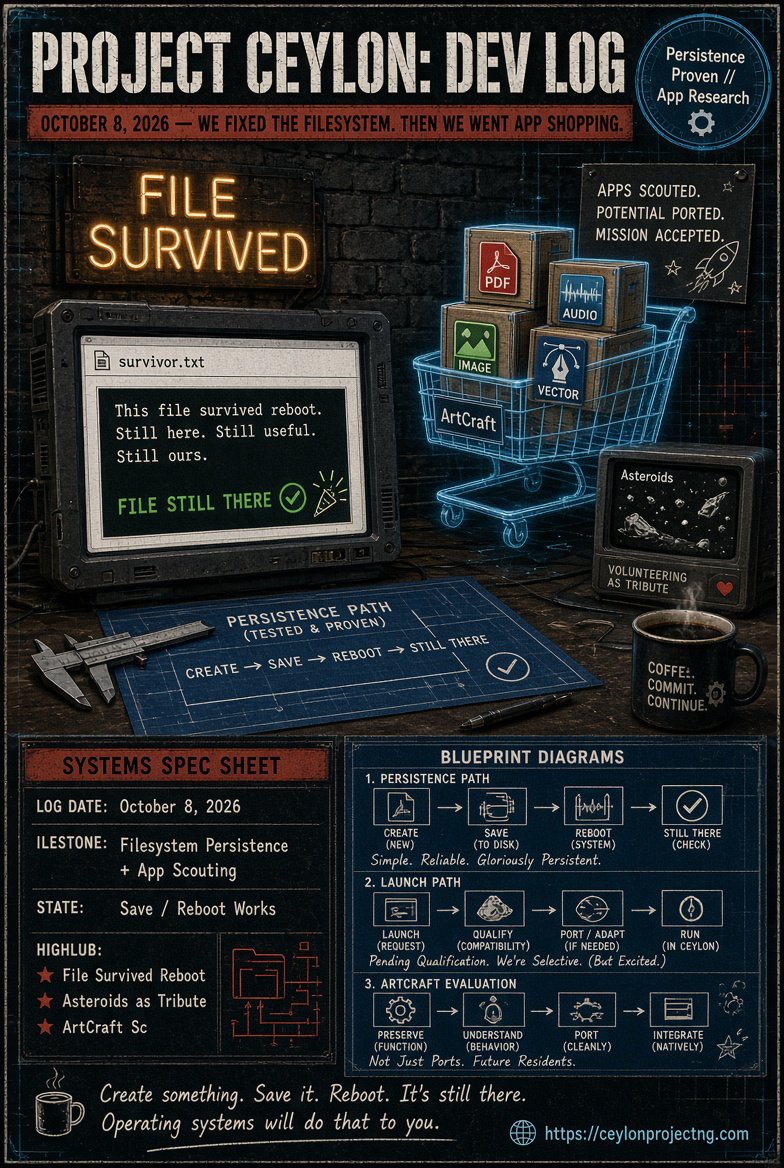
Project Ceylon Development Log — October 8, 2026: We Fixed the Filesystem. Then We Went App Shopping.
10/09/2026 at 23:22 • 0 comments![]()
Today Ceylon did something deeply suspicious.
It saved a file.
Then it rebooted.
Then the file was still there.
I know. Wild stuff.
For a normal computer, this is not exactly a headline feature. For an operating system we're building from the microkernel upward, though, persistence is one of those wonderfully ordinary things that requires a ridiculous amount of machinery to be correct underneath it.
And today we got a much better handle on that machinery.
Storage Finally Behaved Like Storage
The filesystem repair work moved from "we think we know what's wrong" into an actual qualified fix.
The repaired path passed the ext4/JBD2 tests, created and read a 6,144-byte file, edited and saved a 9,216-byte file, rebooted the machine, and recovered the data afterward.
The resulting image was also reproducible. The governed build inputs and payload checks passed, and we got the same ISO again.
That's the sort of boring result I want more of.
Create something. Save it. Reboot. It's still there.
There are entire layers of engineering hiding under those four sentences.
The application-runtime work also got considerably farther. The core runtime tests reached 48 out of 48, and later filesystem qualification reached 80 out of 80 with the filesystem reaching its Ready state.
But there's an important line I don't want to blur:
Ceylon still has not proven the complete normal application-launch path.
The runtime machinery exists. The filesystem can hold the application. The catalog and drawer concepts exist.
What still needs proof is the entire normal path from:
application on disk → discovery → drawer → user selection → launch
No cheating with a test fixture or direct invocation.
If I click the thing, the thing should run.
Apparently that's considered desirable in desktop computing.
Asteroids Volunteered as Tribute
We've been looking for a small real application to use as the first proper windowed-app qualification target.
Asteroids is getting that job.
The host-side version is in decent shape. Its tests passed, and the repaired demo ran for 1,800 frames.
What it does not have yet is the complete Ceylon-side entry point, packaging, NuGUI adapter and normal discovery/launch path.
That's actually useful.
A tiny game is a much better application-runtime test than a fake "hello window" program because it wants input, drawing, timing and a real event loop.
And if the application loader is broken, at least eventually we'll be able to demonstrate the failure with an asteroid.
Then We Went Rummaging Through Somebody Else's Workshop
A large part of today was application research.
We spent time looking closely at the open-source ArtCraft family of Rust applications.
There are twelve projects in the set, covering areas like PDF work, audio, image editing, vector graphics and other creative and productivity tools.
Rather than immediately forking everything and announcing that Ceylon now has twelve new applications—which would be an excellent way to create twelve new problems—we took the less exciting route.
We preserved exact source snapshots, pinned the versions, recorded the manifests and hashes, reviewed the dependencies, reviewed the licenses, and started separating the useful application engines from the assumptions those applications make about their current desktop environment.
In other words:
Preserve first. Understand second. Port third.
No ArtCraft application was proven running on Ceylon today.
That's the research result, not a disappointment.
The interesting part is that several of them look potentially reusable if we can give them a proper Ceylon application/runtime layer instead of attempting to drag an entire foreign desktop framework into the operating system.
NuGUI Does Not Need to Become egui
That led into a useful UI discussion.
A number of the ArtCraft applications use Rust's
eguitoolkit.NuGUI and egui are not the same kind of thing.
NuGUI is part of Ceylon's desktop architecture. egui is an immediate-mode application GUI toolkit.
So the current thought is not:
Replace NuGUI with egui.
It's closer to:
Can we create a clean adapter that lets an egui application live inside a normal Ceylon/NuGUI window?
That would be considerably more useful.
It could give us access to existing Rust application UI code while preserving the desktop, application lifecycle and system contracts we're already building.
We also found some ideas in the ArtCraft interfaces worth studying independently—layout patterns, controls, pane organization and other small interaction details.
That's research, not a NuGUI redesign.
Steal the good ideas.
Not the architecture.
The PDF Reader Is Probably First
If the application-runtime path behaves, the current preferred sequence is deliberately conservative.
A restricted PDF reader is a good first target.
PDF gives us a real document engine, scrolling, rendering, file access and interaction without immediately requiring a giant editing application.
After that, some of the other ArtCraft engines become more interesting.
SoundCraft could provide useful audio and DSP experiments. Image and vector tools could exercise richer graphics and document workflows.
But there's no point porting all of them until we've proved the common runtime path once.
One application working properly is more valuable right now than twelve application icons that don't.
I'm learning.
Slowly.
Where We Ended the Day
The filesystem is substantially healthier.
Persistent create/edit/save/reboot behavior passed.
The application-runtime core has a strong body of tests behind it.
We have a small application ready to become the first normal windowed-launch target.
And we found a useful collection of Rust applications and engines that may save us from reinventing quite as many wheels as I originally expected.
The less-good-but-important news is that the complete user-facing application path still isn't qualified.
We haven't proven normal drawer discovery and launch.
Asteroids is not yet running as a proper Ceylon application.
And none of the ArtCraft applications has been ported.
That's fine.
Yesterday we were still asking how we were going to get useful applications onto this operating system.
Today we have source code, licenses, candidate engines, a better idea of how Rust applications might fit into NuGUI, and a filesystem that can actually remember what we put on it.
That's a pretty decent Thursday.
And yes, I remain disproportionately pleased that the file was still there after reboot.
Operating systems will do that to you.
-
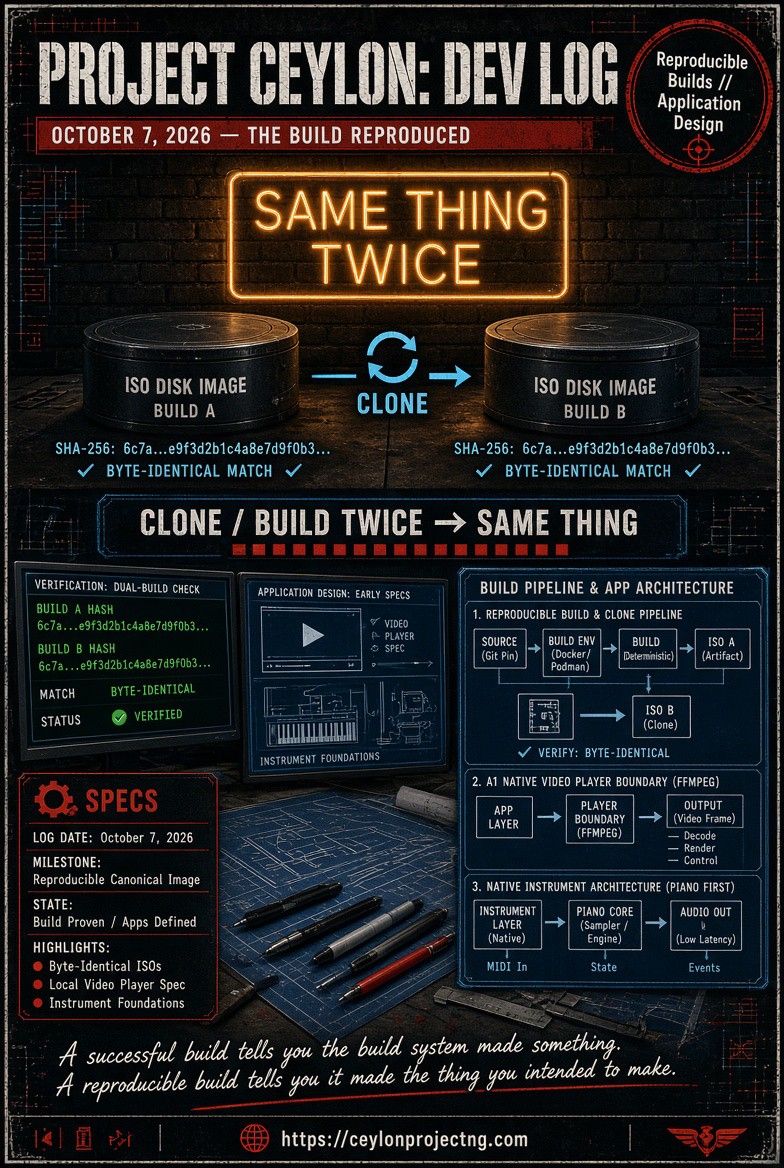
Project Ceylon Development Log — October 7, 2026: The Build Reproduced. Then We Started Designing What Runs on It.
10/09/2026 at 02:33 • 0 comments![]()
Mike · October 7, 2026
Tags: Project Ceylon, Operating Systems, Reproducible Builds, Storage, Browser, Video, Audio, FFmpeg, VST, Applications
Yesterday was mostly about figuring out what kind of applications Ceylon eventually needs if this thing is supposed to become somebody's actual computer.
Today started by making sure we can reliably build the computer underneath them.
That seems like the correct order.
It would be slightly embarrassing to spend months designing a browser, video player and music-production environment only to discover that two nominally identical Ceylon builds are actually different machines.
So a significant part of today's work went back down into the build and qualification machinery.
And, for once, it gave us a pleasantly boring answer.
Build it twice. Get the same thing twice.
That's a milestone I will happily take.
The Build Finally Had to Prove Itself
We've been tightening the Ceylon build process for a while now.
The rule we've settled on is deliberately unforgiving: there is one governed candidate, one expected source baseline, one manifest describing what belongs in the image, and one qualification process.
If an expected input is missing, that's a failure. If an input is the wrong one, that's a failure. If a payload doesn't match what the manifest says should be there, that's a failure.
No "well, the ISO still booted."
No quietly grabbing whatever happens to exist in an old build directory.
No reconstructing history from shell scrollback three days later.
Today's canonical image run got through that process cleanly.
All 7 expected build inputs were accounted for. All 46 expected payload checks passed on the first build.
Then we built it again.
All 46 passed again.
More importantly, the two ISO images were byte-for-byte identical, with the same SHA-256 hash.
That is considerably more interesting to me than "the build completed successfully."
A successful build tells you the build system made something.
A reproducible build tells you it made the thing you intended to make.
The resulting image also made it through the initial QEMU smoke path: GRUB loaded, the microkernel started, the system environment came up, and the Intel IOMMU configuration was present.
So the build side of the machine is getting much less mystical.
Good.
Mysticism is a terrible dependency manager.
Runtime Testing Immediately Found Something Else
Naturally, once the build process stopped being the problem, runtime testing found something else to complain about.
One test configuration produced what looked like an RNG failure.
That would have been irritating because the RNG path has already been through quite a bit of qualification.
It turned out the failure wasn't really about the RNG.
The wrong QEMU invocation had been used.
A one-drive configuration had been run where the intended machine expected the fuller storage setup.
That changes more than "there is one less disk."
Ceylon's qualification work increasingly treats the complete machine definition as the artifact: devices, ordering, storage layout, firmware, launch arguments, everything.
So testing the wrong launch configuration and then blaming whichever service screams first is not particularly useful.
Once that was understood, the storage investigation got more interesting.
Storage Managed to Make Logging Look Guilty
One of the problems we found involved filesystem metadata being damaged during a run.
For a while that looked suspiciously like the storage stack itself had gone off the rails.
The trail eventually led somewhere stranger.
Diagnostic logging activity had managed to overwrite part of the ext4 image metadata.
That is the sort of sentence that makes perfect sense after you've spent enough time building an operating system and absolutely no sense before.
The other storage issue was architectural rather than corruptive: one composition path only represented a single block device even though the QEMU machine had a second drive attached.
So from QEMU's point of view the hardware existed.
From part of Ceylon's composed system point of view, it effectively didn't.
Those discoveries are useful because they tighten the question we're asking next.
We're no longer just asking whether a storage test prints something encouraging.
We're asking whether the actual physical block path, composition, publication and filesystem layers all agree about which devices exist and who owns them.
Storage is therefore not being declared finished.
The current build baseline is much stronger.
The remaining storage work needs proper block-layer verification before we promote another "looks good from here" into "qualified."
We've learned that lesson enough times now.
Meanwhile, We Designed a Video Player
Because apparently one operating-system investigation at a time is not enough.
We've known A1 Alpha needs a video player.
The interesting question today was how much video player.
VLC naturally came up because it is open source and because VLC's networking support is extraordinarily useful.
It can open local media, network streams, playlists and all sorts of things that align very closely with where we eventually want Ceylon's video workflow to go.
IPTV was particularly interesting.
There are public playlist projects such as IPTV-org that make the basic model easy to understand: a playlist identifies network video sources, the player opens one, and suddenly "video player" starts growing toward television, network media and eventually broadcasting.
That future direction is attractive.
It is also absolutely not what A1 Alpha needs first.
So we narrowed the Alpha player aggressively.
The current A1 direction is a native Ceylon video player using a reduced, pinned FFmpeg build as the likely media engine.
No browser dependency. No Linux sidecar. No GPU requirement. No network service required to play a local file.
The initial target is deliberately mundane: open a normal MP4, decode H.264 video, decode AAC audio, present the video through NuGUI/Nu-Iris, send audio through Lyra, and provide the usual play, pause, seek, replay, resize, fullscreen, volume and mute controls.
That doesn't sound particularly exotic.
That's the point.
The difficult part is making those ordinary behaviors dependable when the operating system underneath them is ours too.
The Video Work Turned Into a Specification Exercise
We didn't stop at "FFmpeg can decode video."
We looked at the less glamorous parts that determine whether a player is actually usable.
What happens when a file is truncated? What happens if the decoder stalls? What happens if audio and video drift? What happens when somebody seeks repeatedly? How much memory may a decoder consume? What happens when a provider disappears underneath playback? What happens when the user closes the application while decode work is still in flight?
Those are much more useful questions than asking how quickly we can get one movie frame onto the screen.
The resulting video-player specification went through two gap-analysis passes, and the problems we found were folded back into it.
The larger architecture deliberately leaves room for later network streaming, IPTV playlists, HLS and other streaming protocols, subtitles, recording, CeylonTV integration, editing and broader digital-video workflows.
But those belong on the far side of the Alpha boundary.
A1 gets the player.
Later Ceylon can get ambitious.
That sentence should probably be printed above my desk.
The Browser Is Still Research, Not a Port
The browser work from yesterday continued as research rather than implementation.
That's an important distinction.
We are not claiming that Ceylon suddenly has a browser.
We are trying to construct an experiment that tells us what kind of browser we ought to build.
The current Round 1 direction is a standalone Rust application with a Linux-hosted development path first and Ceylon-specific adapters later.
Blitz remains an interesting provisional HTML/CSS renderer.
NetSurf remains a possible fallback if that experiment tells us Blitz is the wrong fit.
Servo is still interesting research, but not something we're pretending we can casually drop into A1.
Before any serious porting work starts, the browser plan now has an explicit qualification gate.
We need to pin the actual dependencies and prove enough of the surrounding application behavior—interaction, runtime boundaries, presentation and isolation—that we know what we're carrying onto Ceylon.
Again, this is research.
The point of the research is to make the eventual implementation smaller and less stupid.
I consider that a good use of time.
Then We Wandered Into Musical Instruments
The audio side got some attention too.
The DAW, sequencer and soft synth planned for Ceylon eventually need useful instruments.
Not toy instruments that exist only so we can say the synth makes noise.
Useful ones.
The first target we've been discussing is a proper sampled grand piano.
A grand piano is a good starting point because it is musically useful across an absurdly wide range of material, and because doing it properly forces us to solve several foundational instrument problems early.
Sample organization, velocity layers, release behavior, streaming, memory mapping, instrument definitions, plugin boundaries and real-time behavior all have to be considered.
We looked at permissively usable/open resources including the Salamander Grand Piano and Iowa piano samples, along with some existing engines and plugin projects that can teach us how the problem has been approached elsewhere.
The longer-term idea is a native Ceylon instrument and effects ecosystem.
Piano first.
Then other keyboards, bass, drums, synths and orchestral instruments.
After that, the less glamorous but equally necessary equipment: EQ, compression, limiting, delay, reverb, amplifier and speaker-cabinet modeling, and potentially convolution tools.
Eventually, if the architecture earns it, a proper Ceylon plugin development kit.
That doesn't mean we've implemented a VST host today.
We haven't.
It means we're beginning to define what "native professional audio applications" actually requires instead of waiting until the DAW exists and discovering it has nothing worth loading.
There’s a Pattern Emerging Here
Today's work looks scattered if you reduce it to nouns.
Build system. Storage. Video. Browser. Piano samples.
But they're all answering the same broader question:
What has to be true before Ceylon becomes more than an operating system that boots?
The build has to be reproducible.
Storage has to preserve the things applications create.
The browser has to connect the workstation to the modern web without turning Ceylon into a disguised Linux dependency pile.
The video system has to handle ordinary media reliably before we start dreaming about television and broadcast workflows.
The music applications need instruments worth playing.
And all of those applications need to sit on top of the same coherent machine rather than each bringing a private operating system along for the ride.
That's a much larger project than getting a framebuffer on screen.
We knew that.
I don't think we appreciated quite how many interesting rabbit holes would appear between "it boots" and "I can spend my day using it."
Where We Ended the Day
The canonical Ceylon image is now being built under a considerably stricter reproducibility model.
Two governed runs produced the same checked payload set and the same ISO.
The image reached the expected initial QEMU boot environment.
Runtime testing exposed configuration and storage-path problems that are now better understood instead of being papered over.
Storage still needs additional qualification.
The A1 video-player direction is substantially better defined: keep Alpha local, native and dependable; use a reduced FFmpeg engine; leave IPTV and the larger digital-video ambitions for later.
Browser work remains in the research/specification phase, with a smaller Rust-first experiment taking shape rather than immediately attempting a heroic Chromium port.
And on the audio side, we've begun turning "Ceylon should have a synth" into the much more useful question of what professional native instruments and plugins should actually look like.
None of those application discussions magically added applications to Ceylon today.
That's fine.
Today gave us something we need first: better definitions of the problems we're actually trying to solve.
And underneath all of it, we can now build the same ISO twice.
For an operating-system project, that's a pretty good way to end the day.
Project Ceylon: What If the Amiga Never Died?
What if Commodore had never gone bankrupt and Amiga development had never stopped?