 Next Builder


We usually think of an air-quality monitor as a device that measures the environment and displays a few numbers. But those numbers don't always tell us what is actually happening or what we should do about it.
Atmosis was built to bridge that gap.
Atmosis is an intelligent environmental monitoring and advisory system built around the Arduino UNO Q. It combines real-time environmental sensing, edge machine learning, Linux-based processing, generative AI, and remote notifications to turn raw environmental data into useful information.
The system continuously monitors parameters such as IAQ, TVOC, formaldehyde, carbon monoxide, temperature, humidity, PM2.5, atmospheric pressure, and altitude. Rather than treating each measurement independently, Atmosis looks at how these values change together to identify meaningful environmental conditions across different environments.
This is where Edge Impulse is used. A machine-learning model trained with data collected from the same sensors learns the patterns between multiple environmental parameters and classifies conditions such as clean air, traffic pollution, construction dust, indoor pollution, poor ventilation, biomass burning, and unusual events. The model runs locally, allowing the core environmental analysis to happen directly on the device.
The Arduino UNO Q is what brings the different parts of the system together. Its STM32U585 microcontroller handles the real-time sensor processing, air-quality calculations, status indicators, and safety-related functions, while the Qualcomm QRB2210 Linux processor runs the higher-level software, including Edge Impulse inference, the dashboard, Telegram communication, and the AI advisor.
Once Atmosis identifies an environmental condition, Google Gemini can be used to interpret the structured data and generate a clear, natural-language recommendation. Gemini is not responsible for the sensor measurements or safety decisions; it acts as an additional intelligence layer that makes the detected information easier to understand.
Because Atmosis can also work with personal sensitivity information, privacy is considered as part of the architecture. Sensitive health information can remain on the UNO Q, while only the necessary environmental data and a privacy-safe sensitivity context are provided to the AI service. The resulting advice is then returned to the device and can be shown on the local dashboard or delivered through Telegram.
The system is also designed so that its core monitoring and safety functions do not depend on the Internet. If the cloud services or Linux application become unavailable, the microcontroller can continue monitoring the environment and handling the essential hardware-level responses.
At its core, Atmosis follows a simple process: Sense → Understand → Interpret → Respond
The sensors provide the data, the UNO Q processes it, Edge Impulse recognizes the environmental pattern, and the AI layer turns that information into something a person can actually understand and use.
Atmosis is not just another environmental monitor. It is an attempt to make environmental data more intelligent, more useful, and more adaptable — across indoor spaces, outdoor conditions, pollution events, and changing environmental situations — while keeping the important parts of the system local and dependable.
How Atmosis Work
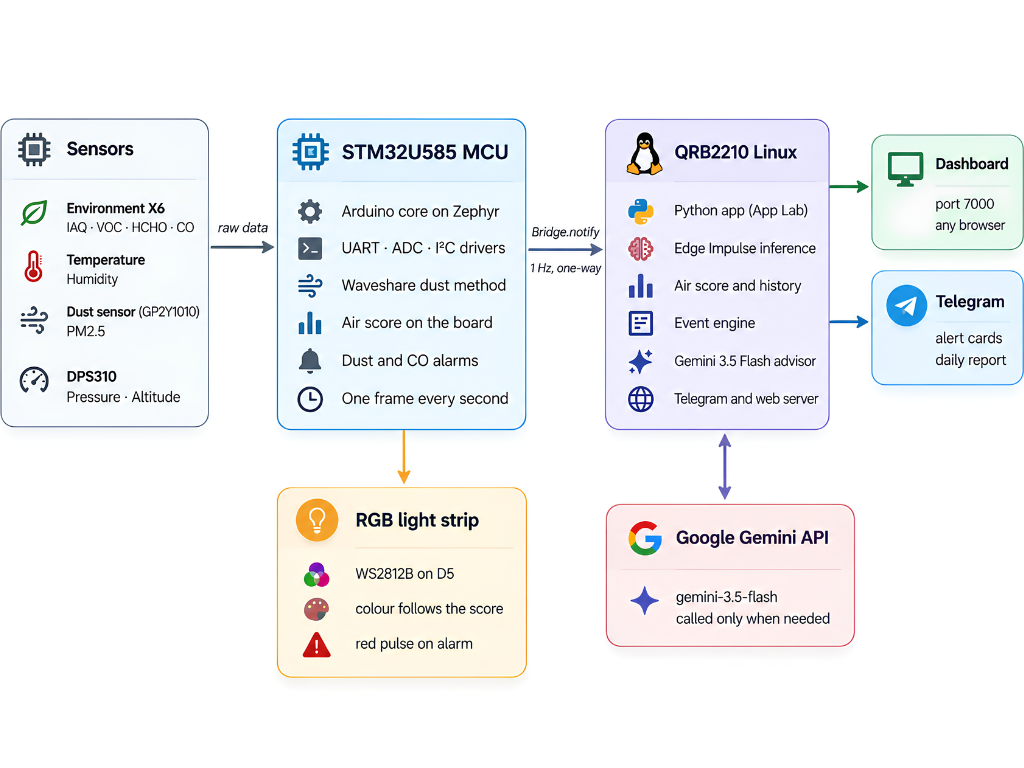
Atmosis follows a layered architecture where each part of the system has a specific role. Raw sensor measurements are progressively transformed into environmental status, pattern recognition, and actionable information.
Three sensors continuously provide nine environmental parameters: IAQ, TVOC, HCHO, CO, temperature, humidity, PM2.5, pressure, and altitude. The STM32U585 handles these measurements in a non-blocking firmware loop, calculates the air score, controls the WS2812B status light, and responds to critical PM2.5 and CO conditions directly on the board.
The processed data is then sent once per...
Read more »

 TURFPTAx

 sheikh

 Davide Cagnoni

 designlab.ac