 Gabriele


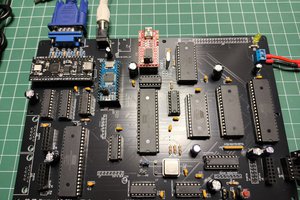
The system boots from the 8 KB ROM, that holds a firmware which barely weights above 3Kb. It initializes the SD card using one of the two integrated 65C22 VIAs, on which I implemented a bit-banged SPI protocol management.
Once the card is initialized, it goes on to initialize and read the FAT32 file system on it, searching for a file called SYS.BIN located in the root directory which is loaded at address $0300 and then executed.
Currently, the default firmware (SYS.BIN) from the card runs GS-DOS, a microkernel I wrote myself, which implements pseudo-DOS commands to manipulate memory, load binary files into specified memory locations, and execute them. Typing the command 'MON' it runs the most classic and iconic system monitor ever made: Wozmon, adapted for my system.
Once booted, GS-DOS disables the ROM, initializes the TMS9918A, prepares the keyboard scan (using the second VIA on the board), activates the bank register and sets it to 1, freeing up 32 KB of contiguous RAM, located at the top of the address space, in the range $8000–$FFFF.
The bank register uses 15 different slots to move a 32 KB window across the 512 KB of available RAM. The bottom half of the memory address space is deliberately fixed and detached from the banking logic so it can be accessed at any time.
In addition to zeropage and stack, it also contains the peripheral address space (I/O), located between $7F00 and $7FFF.
Software development is progressing more slowly than I'd like, but I managed to port MSBASIC and run some demos to take advantage of the TMS9918A and play a very popular song through the Commodore SID.
The latter represents the classic bottleneck, as it has a speed limit that prevents it from operating at frequencies above 1 MHz. A 65C22 can solve this problem, but it comes with a performance penalty and additional software complexity.
GS-X65 System Specifications:
- WDC 65C02 (1 - 10MHz).
- 512Kb 10ns RAM.
- 8 - 16 - 32KB ROM.
- WDC 65C51 115200 bps Serial Terminal Interface (over USB through an FTDI Chip adapter).
- WDC 65C22 #1 - FAT32 FS on SPI operated SD-Card; - Memory Banking.
- WDC 65C22 #2 - 8x10 matrix custom keyboard (External project); - 2 x Atari Joysticks.
- 5x Full BUS expansion ports.
Currently implemented expansion boards:
- PICO9918 - An RP2040 drop in replacement for the TI TMS9918A (External project).
- SIDKick Pico - A modern drop in replacement for the Commodore SID (External project).
 Eric Wright
 Marek
 Arrow Westervelt