Close
0%
0%

Quiesco

An open-source e-ink monitor for your bedroom: CO₂, temperature, humidity, light and noise, logged every night to your phone over Bluetooth.

Similar projects worth following
You sleep in the same room every night, and you probably don't know what's in its air. Quiesco is a pocket-sized monitor for the bedroom. It measures CO₂, temperature, humidity, light and noise, judges each against a comfort band, and tells you what to do: open a window, close the blinds, turn the heating down. No Wi-Fi, no cloud, no account. The unit logs to its own flash and syncs to a companion app over Bluetooth. Everything is open (PCB, case, firmware and app), and it runs the Arduino bootloader, so you can reflash it from the Arduino IDE. Status: working prototype, firmware and app at 1.0. Next: certification and a crowdfunding campaign in early 2027. Get notified at launch: https://quiesco.rest

Why Quiesco

Environmental monitors have boomed: Aranet, Airvalent and friends made CO₂ tracking friendly. But they are general-purpose. They watch the air, and little else, against office standards.

Quiesco is built for the bedroom. Light and noise matter as much as CO₂ and temperature for a good night, so it measures all of them and judges each one against a comfort band. Every reading is actionable:

When it says……you can
CO₂ is highopen a window or run ventilation
too warm, too coldadjust heating, cooling or bedding
too dry, too damphumidify or dehumidify
too much lightclose the blinds or wear a sleep mask
too loudcheck the insulation or reach for earplugs

And unlike commercial devices, it is completely open and unlocked: it runs the Arduino bootloader, so you can change the firmware with the Arduino IDE or your favourite editor.
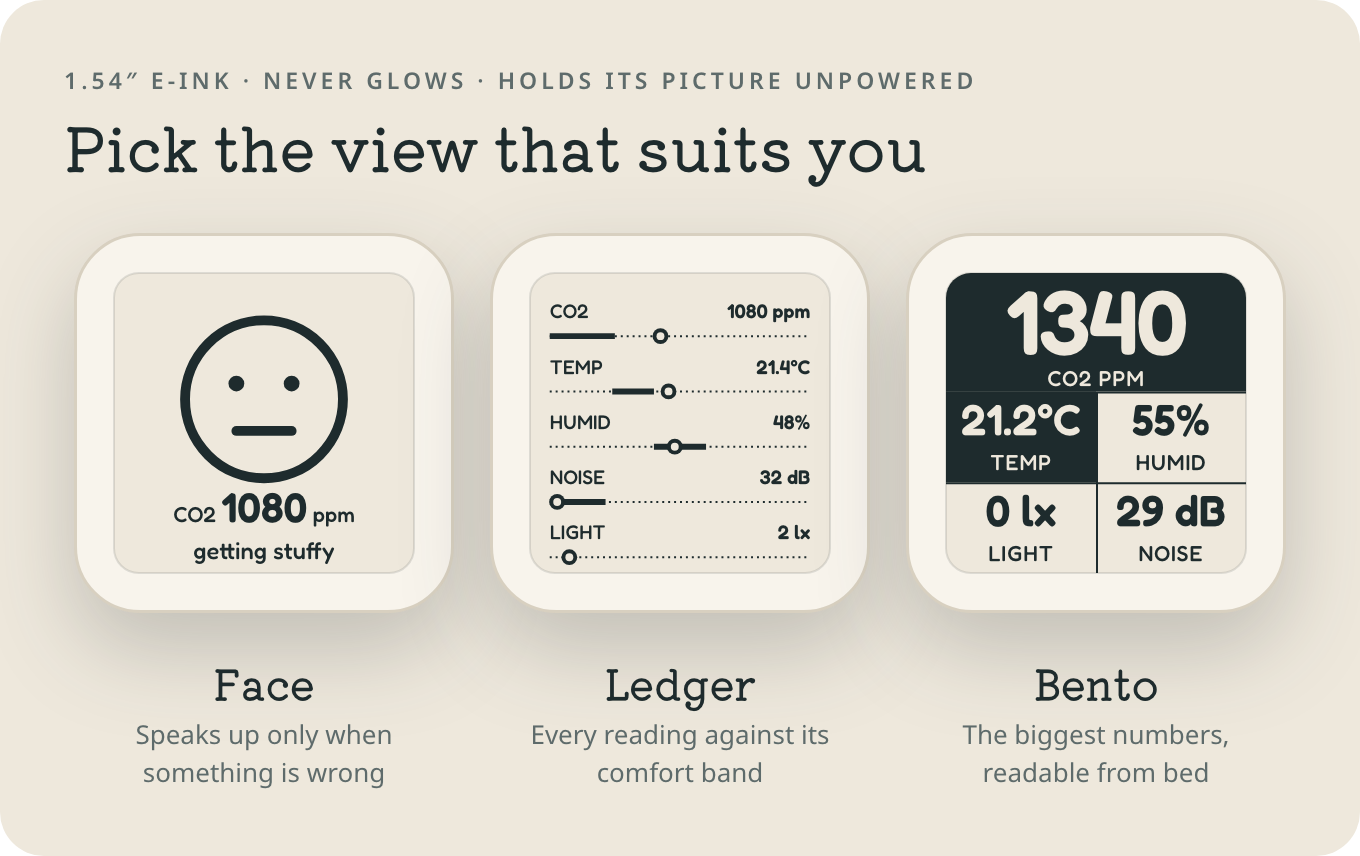
The three e-ink screen layouts: Face, Ledger and Bento

What it measures

ReadingSensorComfortableWarnBad
CO₂Sensirion SCD41 (photoacoustic NDIR)≤ 800 ppm800–1000 ppm> 1000 ppm
TemperatureBosch BME28016–20 °C14–16 · 20–24 °C< 14 · > 24 °C
HumidityBosch BME28040–60 %30–40 · 60–70 %< 30 · > 70 %
NoiseKnowles SPH0641LU4H-1 PDM mic, dB(A) Leq over ~7 s≤ 45 dB45–55 dB> 55 dB
LightVishay VEML7700informational
PressureBosch BME280informational; also compensates CO₂

The same bands drive the e-ink screen and the app, so the phone and the panel always agree.

How it works

Every interval (1, 5, 10 or 30 minutes; default 5 minutes) the unit powers up its sensor rail, measures everything, applies your calibration offsets, appends the reading to its on-board log, redraws the e-ink panel only if the picture changed, then powers the rail down and sleeps. A sensor that fails is reported as unavailable, and the cycle carries on without it.

The app enrols with a unit while it is on USB power, using a six-digit code shown on the panel. After that it sets the clock, downloads the log, charts each night and lets you pick the screen or calibrate the sensors. One phone can hold several units, each with its own name and sleep window.
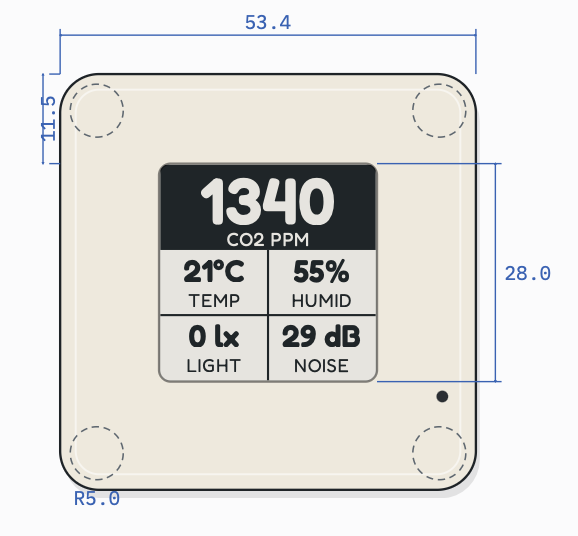
Front view of the enclosure: 53.4 mm square with a 28 mm e-ink window

Specs

MCUNordic nRF52840 on a Seeed XIAO nRF52840 Plus module, Arduino bootloader
ConnectivityBluetooth Low Energy; only an enrolled phone can read data or change settings
SensorsCO₂, temperature, humidity, pressure, light, noise
DisplayGoodDisplay GDEW0154T8D, 1.54″ 152 × 152 e-ink, holds its image unpowered
StorageWinbond W25Q64 8 MB SPI NOR flash (config + sample log)
Power3.7 V ~400 mAh LiPo, USB-C charging, switched peripheral rail
ExpansionJST I²C and UART headers
Case3D-printable two-part enclosure, four M3 screws

Everything (PCB, case, firmware and app) is in the repository: github.com/OxMarco/Quiesco
  • 1 × Seeed XIAO nRF52840 Plus MCU module, Arduino bootloader
  • 1 × Sensirion SCD41 CO₂ sensor, photoacoustic NDIR
  • 1 × Bosch BME280 Temperature, humidity, pressure
  • 1 × Vishay VEML7700 Ambient light sensor
  • 1 × Knowles SPH0641LU4H-1 PDM microphone (noise, dB(A) Leq)

View all 9 components

  • Choosing a case material: ABS, resin or MJF nylon

    Marco • 10/31/2026 at 14:29 • 0 comments

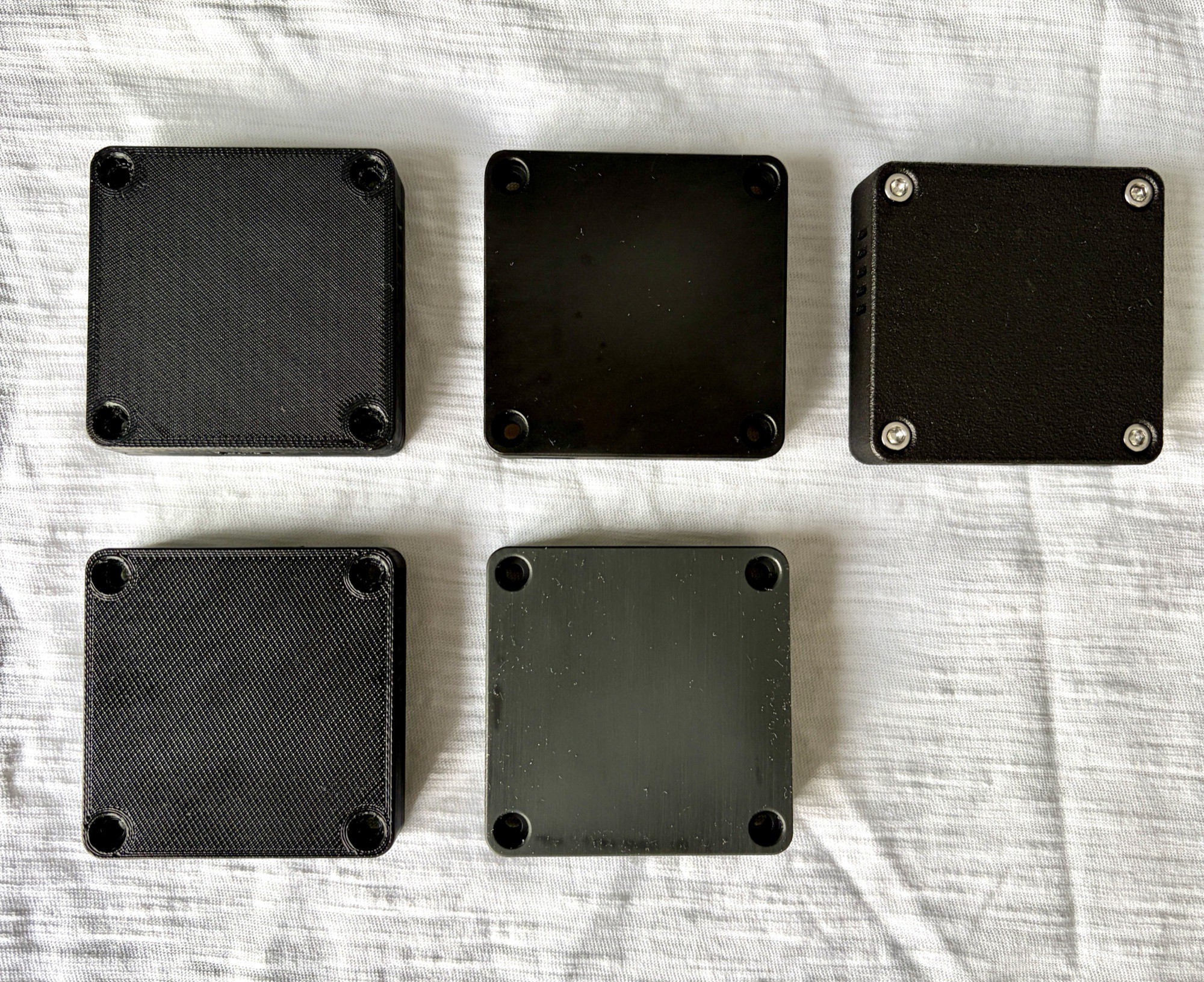
    I had the Quiesco case printed in three processes from the same files: FDM ABS, black resin and MJF PA12 nylon dyed black. The photo shows the back of each shell: ABS on the left, black resin in the middle, and the MJF nylon unit on the right, closed with its four M3 screws.

    FDM ABS. The cheapest, but the layer pattern shows across the whole back and in the screw counterbores. Fine for a prototype on your desk, not finished-looking. The 3.4 mm bezel is also too thin for some FDM services: JLC3DP's FDM needs at least 10 mm of height.

    Black resin. The smoothest surface, and that's the problem: it shows every speck of dust, scratch and fingerprint. The standard black also came out greyish, with visible streaks. Imagine Black is a deeper black but softens at 46 °C, which is a poor fit for a device that might sit on a sunny windowsill. Resin is also generally more brittle where the screws bite.

    MJF PA12 nylon. An even matte black with a fine grain that hides marks. Both side vents printed clean with no support residue, the screws thread in fine, and the parts are tough rather than brittle. It costs about $5 a case at 50 units, a bit more than resin, and worth it.

    One defect. There's a small dot on the front bezel over each screw. Each screw sits in a blind pilot hole that stops 0.5 mm short of the front face, and MJF lets that thin skin show through. The fix is to make the holes 0.5 mm shallower. That leaves a 1.0 mm skin, and the M3×10 screws still clear the bottom of the hole with the same thread engagement. The revised files are with the CAD designer now.

    So the case will be MJF nylon. The STEP and STL files are in the repo under hardware/case/: github.com/OxMarco/Quiesco

  • Why I built a bedroom monitor, and what the Aranet doesn't measure

    Marco • 10/16/2026 at 11:03 • 0 comments

    I own an Airvalent and a couple of Xiaomi sensors, and I've had an Aranet4 on my desk for a review. They're good at what they do: they made CO₂ tracking friendly and put a number on the stuffy-room feeling. But they're general-purpose devices, and they judge the air against office standards.

    My problem was the bedroom. I wanted to know why some nights were worse than others, and CO₂ was only part of the answer.

    What's missing

    The Aranet4 measures CO₂, temperature, humidity and pressure. For a bedroom, two of the things that matter most aren't on that list:

    • Light. A street lamp through the blinds or a standby LED across the room is easy to miss once you're used to it. Quiesco has a Vishay VEML7700 and logs lux all night.
    • Noise. Traffic, a neighbour's AC unit or a fridge that cycles at 3 am. Quiesco has a Knowles PDM microphone and reports A-weighted sound level (dB(A) Leq over about 7 seconds). It doesn't record audio, only the level.

    The thresholds change too. 24 °C is fine for an office and too warm for most people to sleep in, so Quiesco judges every reading against a sleep comfort band. For example, 16–20 °C is comfortable, and CO₂ above 1000 ppm is bad.

    Numbers you can act on

    I didn't want another dashboard to stare at. Every band maps to something you can do tonight:

    When it says……you can
    CO₂ is highopen a window or run ventilation
    too warm, too coldadjust heating, cooling or bedding
    too dry, too damphumidify or dehumidify
    too much lightclose the blinds or wear a sleep mask
    too loudcheck the insulation or reach for earplugs

    Sensor choices

    Most of the hard decisions were about what to leave out. Many boards lean on the BME280's self-heating or add a VOC gas sensor that draws a lot of current for a fairly vague number. In Quiesco the SCD41 does CO₂ only. Temperature, humidity and pressure come from a BME280 on a switched rail that's powered only during a measurement. Everything sleeps between readings, every 5 minutes by default.

    Open on purpose

    There's no Wi-Fi, no cloud and no account. The unit logs to its own 8 MB flash and syncs to a phone app over Bluetooth. The PCB, case, firmware and app are all on GitHub, and it runs the Arduino bootloader, so you can reflash it from the Arduino IDE.

    Next log: measuring noise as dB(A) on a PDM microphone without blowing the power budget.

    Source: github.com/OxMarco/Quiesco

View all 2 project logs

  • 1
    Build your own

    The full build guide (parts, PCB ordering, case printing, flashing the firmware and enrolling the app) lives in one place so it never goes stale: the "Build your own" section of the README.

View all instructions

Enjoy this project?

Share

Discussions

Similar Projects

Does this project spark your interest?

Become a member to follow this project and never miss any updates