 Tim
Tim

I highlighted the importance of the choice of the transistor for bipolar discrete saturation logic before. The relevant parameters were already well understood in the 1960ies and devices like the 2N709 were devised, based on the technology that was available back then.
What about 2020, sixty years later? Clearly, discrete logic is not within the focus of any transistor manufacturer anymore, so we have to pick what is available. What are important criteria (to me)?
- Speed - low propagation delay.
- Availability - I don't want to work with NOS bought from some obscure vendor. Availability at PCB assemblers would be the best case.
- Package size - SMD is a must. Packages smaller than SOT23 would be perfect.
The last two criteria can be easily evaluated from datsheets and vendors listings. It turns out that the first criterion, speed, is not so easy to asses and merits actually testing things with real hardware.
Click here to view project logs in order.

 I believe i built enough ring oscillators for now.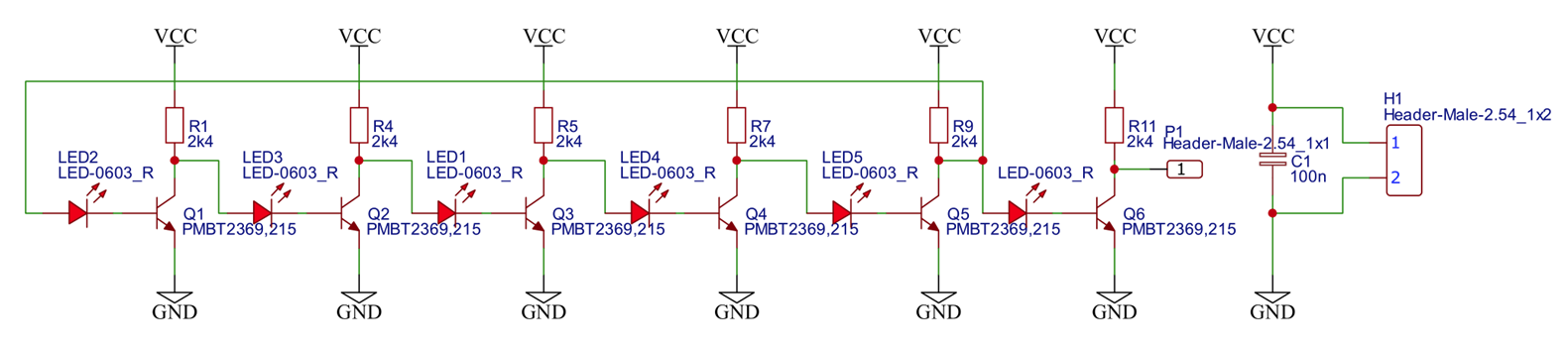
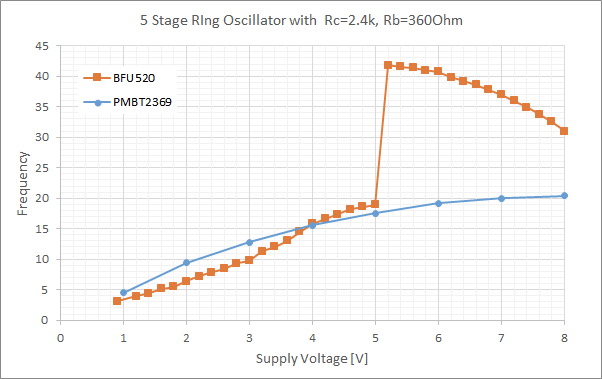
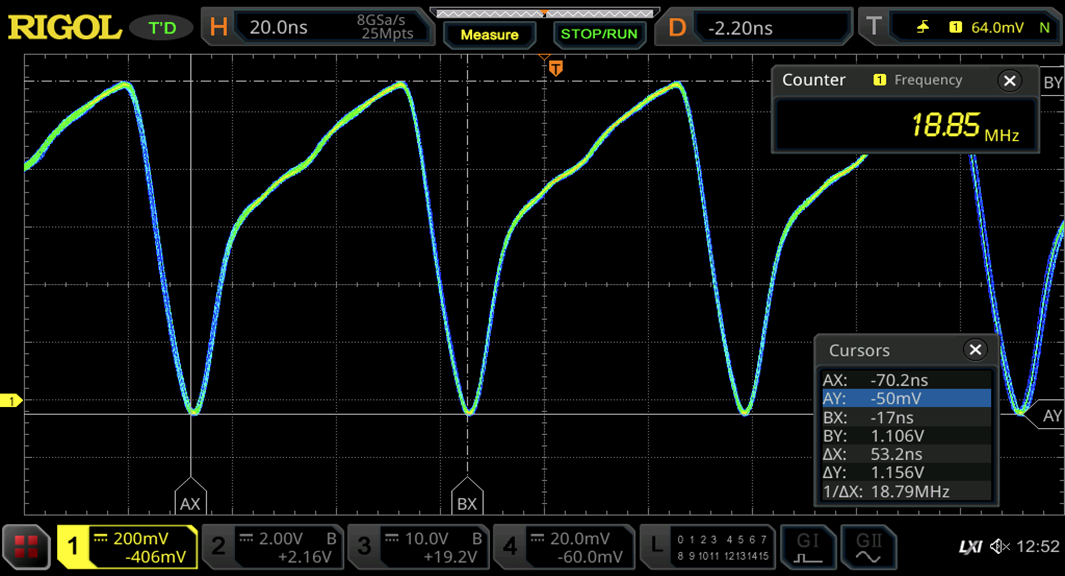
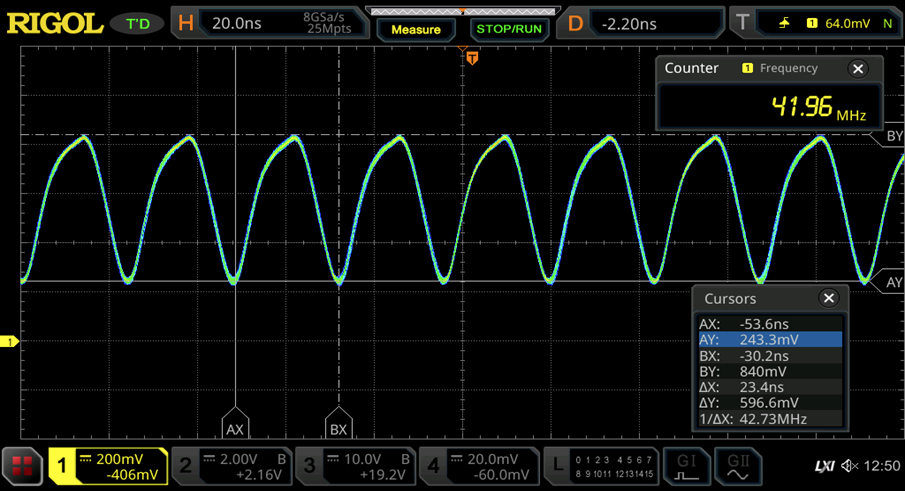
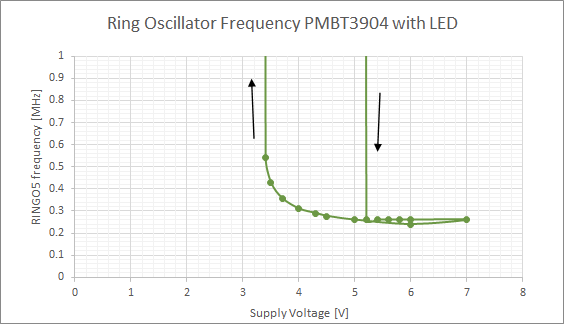
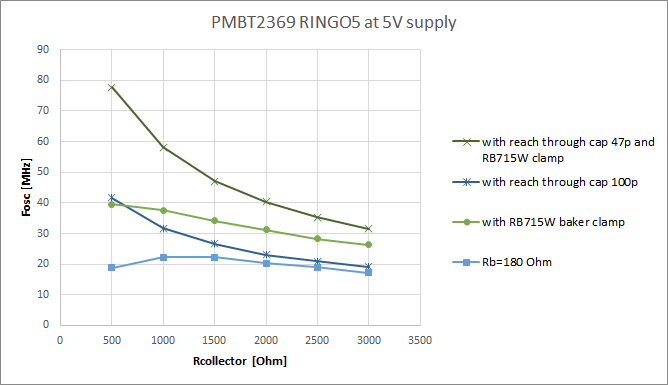
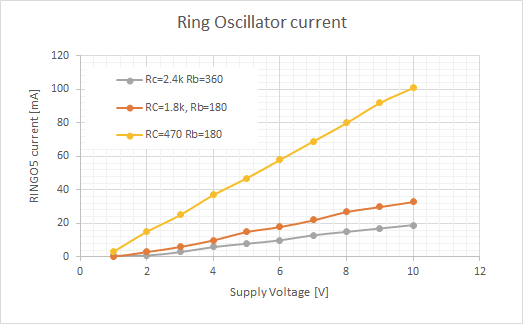
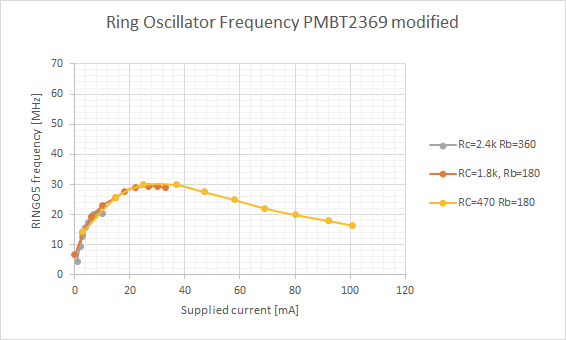
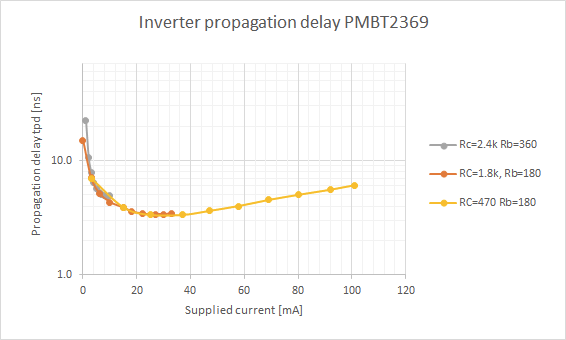
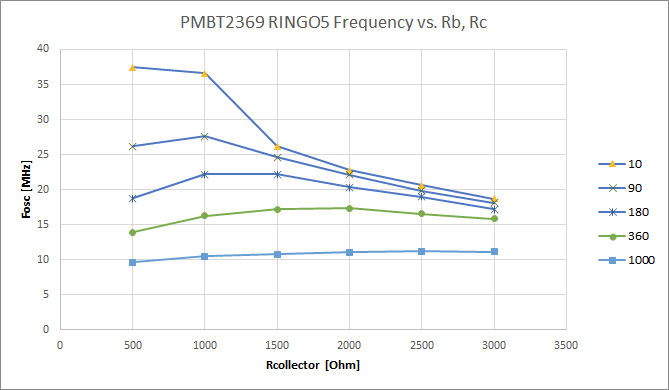
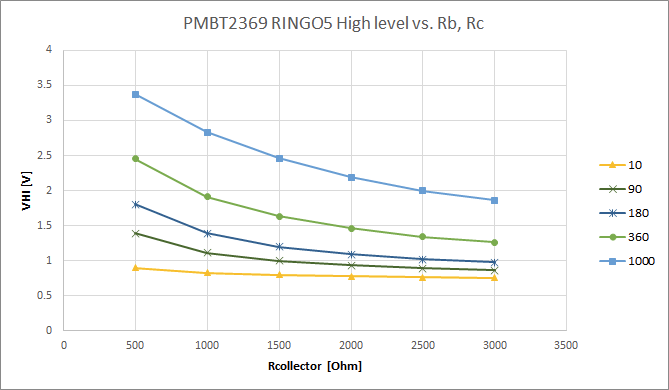
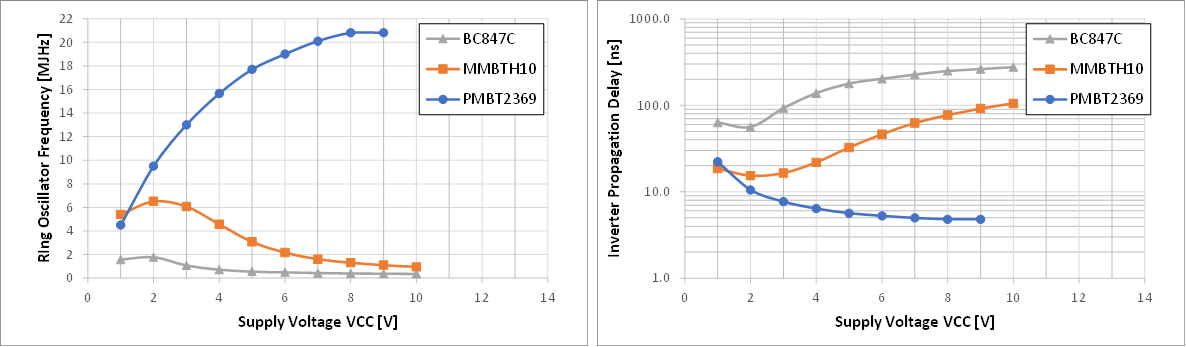
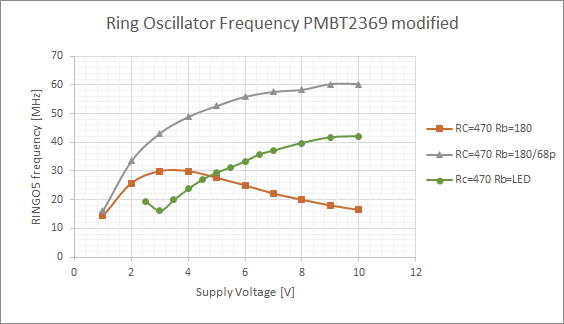 Results for a voltage sweep of the PMBT2369 based ring-oscillator are shown above in green, in comparison with previous results. Two things are apparent: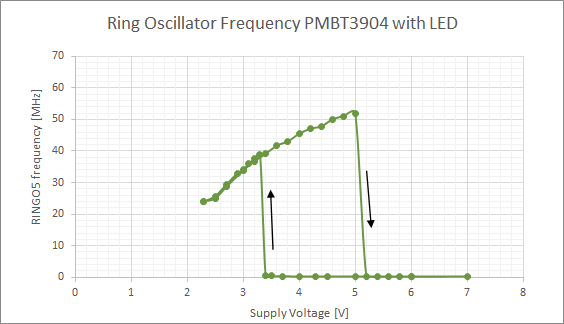
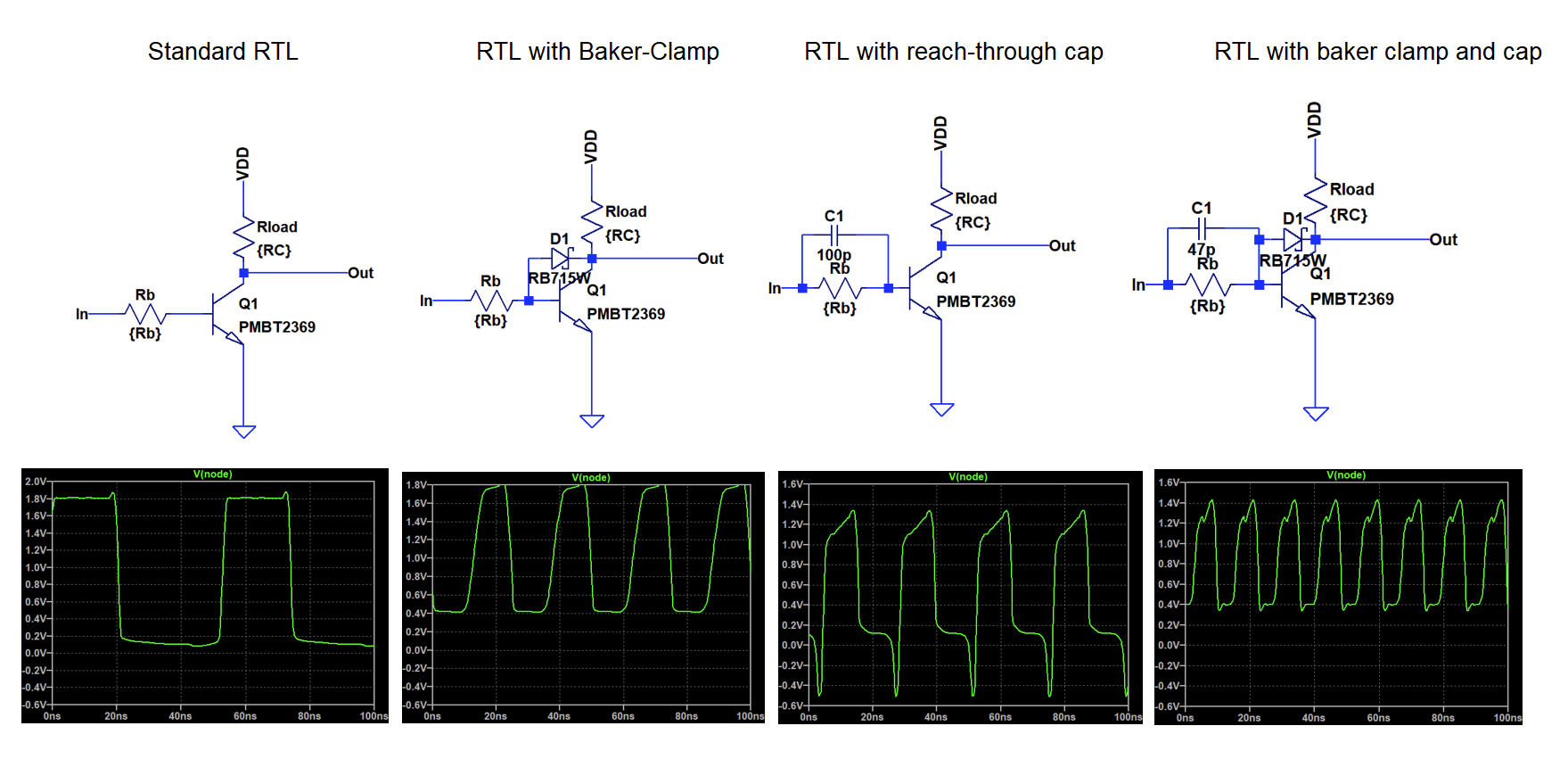
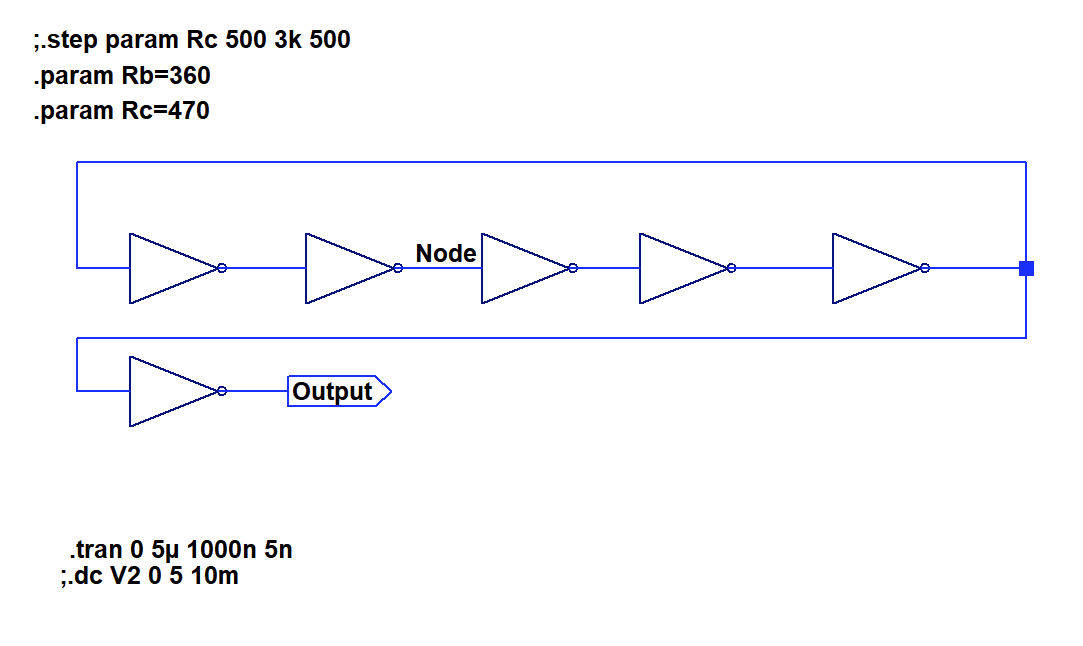
 Spice simulation of the ring oscillator at a supply of 5V shows that both options improve switching speed and the combination of both measures is cumulative. All options use a 180 Ohm base resistor.
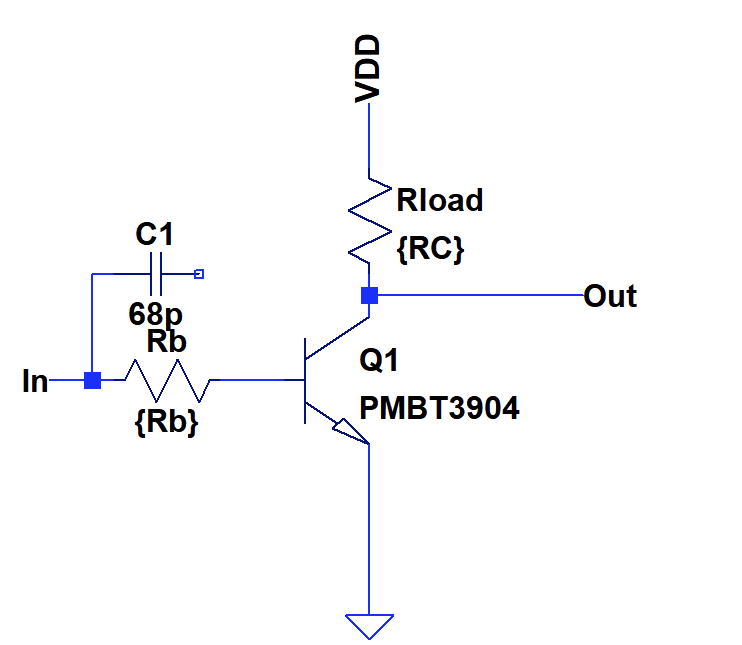
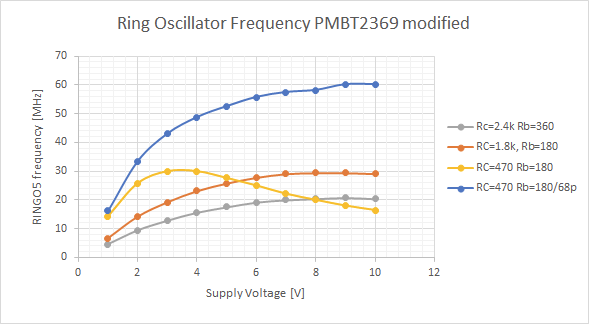 Comparing an RTL oscillator with and without reach-through cap reveals quite dramatic differences. The yellow and blue graphs above are from an oscillator with the same Rb and Rc. The blue one has a 68 pF reach-through cap added in parallel. Due to negative base overdrive, no local maximum of switching speed is observed anymore and the oscillator frequency continues to rise for higher supply voltage/current.
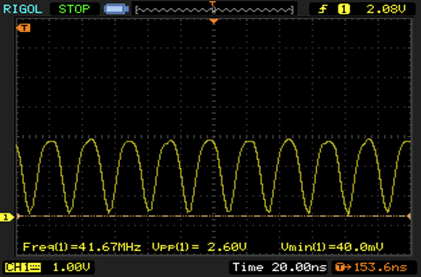
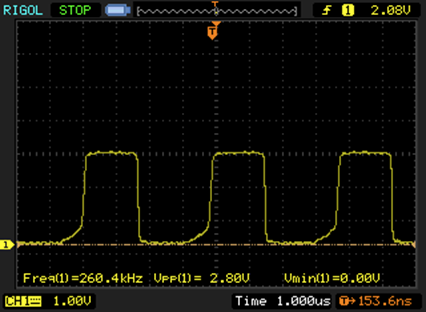
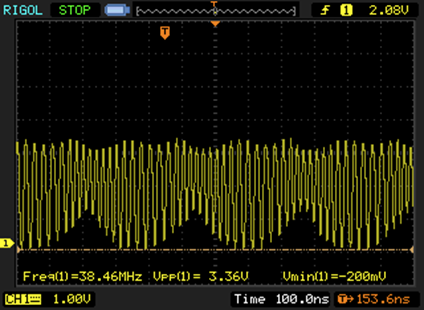
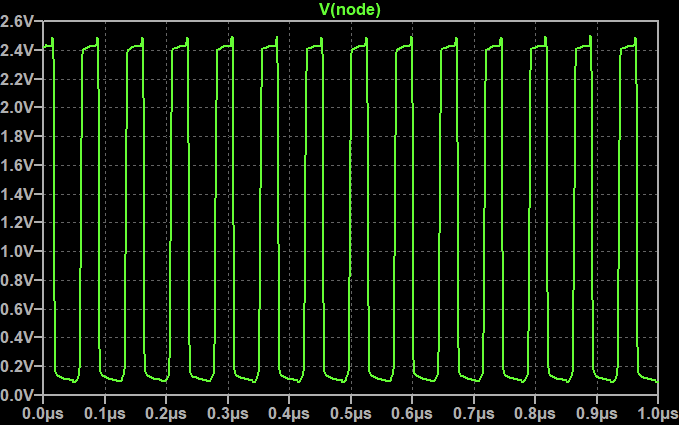
 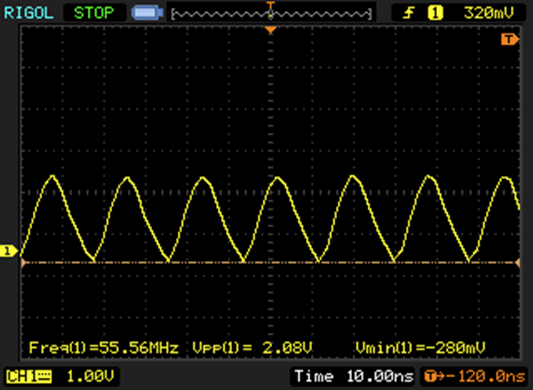 A scope trace shows that, despite the high frequency, there is still fully saturated switching. The signals looks a bit smoothed, which may be caused by bandwidth limitations of my probe and the scope (100 MHz):
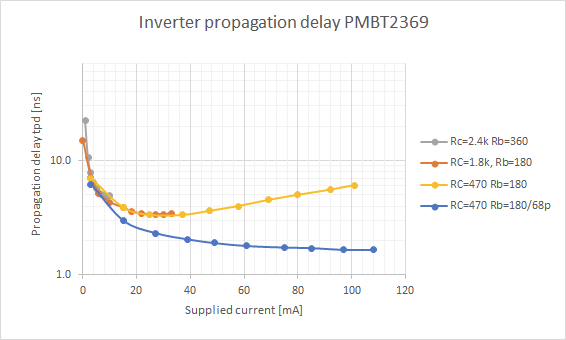 Finally, looking at the bias current / tpd trade off, we can see that the seemingly unsurmountable trend of pure RTL has truely been beaten and less than 2 ns tpd is achieved at higher current. Quite an astonishing result for discrete saturation logic!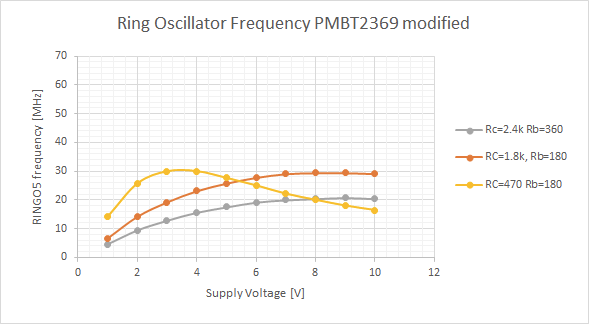
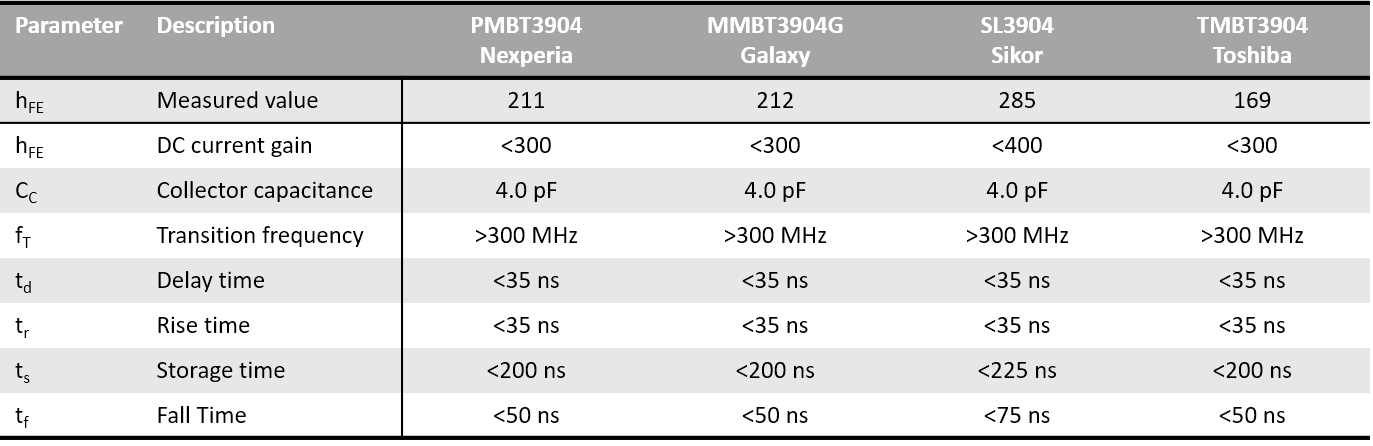 The table above lists the four devices and their respective datasheet values. Siko admits to having a slightly slower device while the other datasheets look like they were copied from each other.
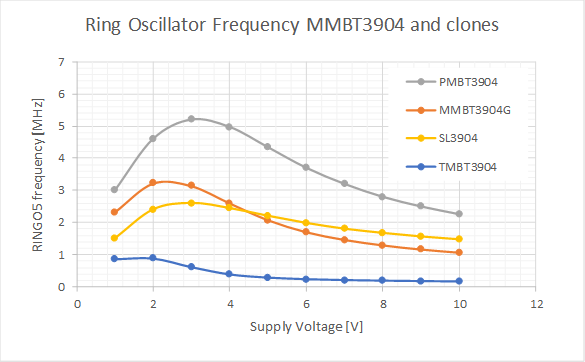 Ring oscillator results are shown above. Minimum tpd is 20ns for the Nexperia device. The others achieve around 40ns, while Toshiba is dead last with >200ns at typical operating conditions.
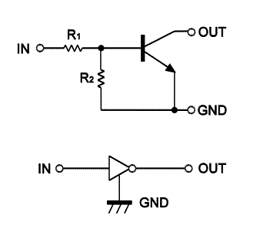 The internal circuit of such a device is shown above. A wide variety of value for R1 and R2 are available. Unfortunately, the minum value for R1 is 1 kOhm, which will already limits switching currents significantly.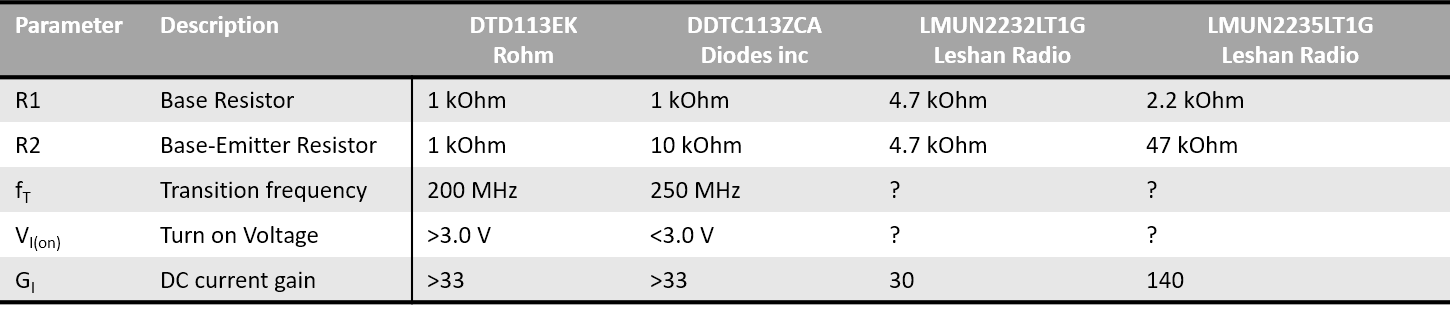
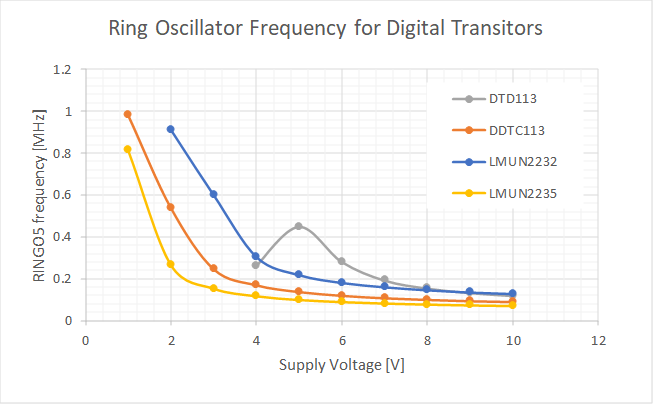 Ring oscillator results are shown above. Basically all devices enter an operational range where they are limited by saturation charge already at very low voltage. Practical gate propagation delays are in the 500-1500 ns range, a hundred times slower than the PMBT2369! There is a very small voltage range where the saturation charge does not dominate and the devices are slightly faster, but it seem impractical to bias devices into that regime.
 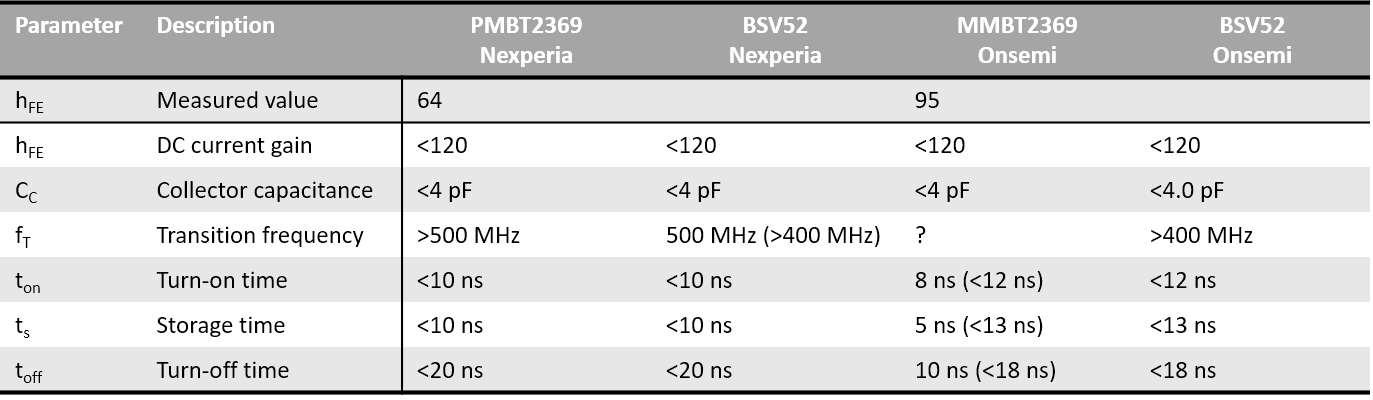 The PMBT2369 is Nexperias offer, my guess is that the "P" stands for Philips. Nexperia was carved out of NXP, which used to be Philips semiconductor branch. Similarily the "M" in MMBT2369 is most likely related to Motorola, which On Semi belonged to a long time ago. The BVS52 seems to be basically the same device at both vendors, so I did not bother investigating it.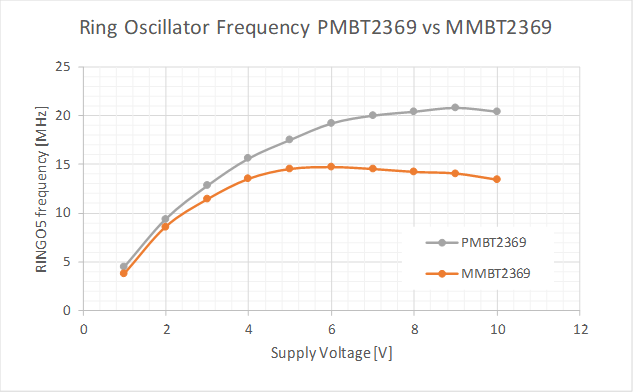




Interesting experiments! The speed peak around 3-volts for comparable resistor choices is not far from RTL itself which is a nice confirmation. Your LED experiment reminded me of high voltage DTL which uses a zener (MHTL) https://archive.org/details/bitsavers_motoroladactronics03MHTL_2135309