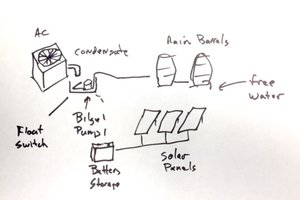
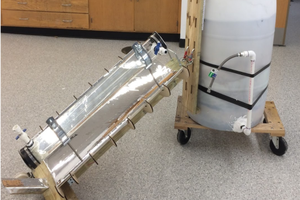
Solar-Powered atmospheric condenser to provide fresh water anywhere that has a suitable relative humidity. For watering plants or drinking.
To make the experience fit your profile, pick a username and tell us what interests you.
We found and based on your interests.
Create an account to leave a comment. Already have an account? Log In.
Thanks for the input! You've made some excellent and succinct points. I'll make some general comments for the benefit of other readers.
Our prototype is being controlled by an arduino and a cheap temp/humidity sensor. This is capable of calculating a rough relative humidity and dew-point. I agree that time of day will be an issue. Maximum solar will not have the closest dew point. Battery/super-cap storage (haven't discussed or decided yet) will offer some flexibility, so we can have it operate at the "best time" for the given conditions.
We were looking at surface treatments on the cold-array to promote condensation (hydrophobic and hydrophilic patterns).
Peltiers operate at bout 15% efficiency and draw significant current, the units I have sitting around that we are playing with are 60-80W elements. This will be an issue for any power storage strategy. We will be operating them in PWM for the time being. This will allow us to find a "sweet spot" to run them at in addition to a "soft start" (thermal stress of a constant DC start will break the semiconductor interface).
The peltiers can generate a temperature differential up to 70C, depending on how much heat they have to shift. There is also the ohmic heating of the element during operation. Once they achieve "saturation", they go into runaway and become a basic ohmic heater. With an adequate heatsink and not driving them too hard, they routinely achieve 0 to -10C.
As such, peltiers are problematic.. they are power-hungry and temperamental. However they are relatively cheap, simple to operate and have no moving parts.
We are still reviewing the maths involved. I've got only a passing familiarity at the moment. The main tricks we can exploit to promote condensation is the temperature (current strategy) or atmospheric pressure (more tricky, but also assessing options).
Thanks again for you input! You raised some excellent points. I hope you don't mind me monologuing during the response :)
I imagine this would be quite sensitive to relative humidity--Peltier coolers will give you a relative change vs. ambient temperature, and depending on relative humidity, you may not be able to get enough of a temperature change to get below the dewpoint to trigger condensation. You may want to collect some data to determine these thresholds, and have the microcontroller to be smart enough not to waste power when collection is not possible and instead charge a battery. Also, due to additional power available from a battery, you may be able to extend the range of relative humidity you can support.
Become a member to follow this project and never miss any updates
About Us Contact Hackaday.io Give Feedback Terms of Use Privacy Policy Hackaday API Do not sell or share my personal information
Water from the atmosphere is not really fit for drinking – it is full of tons of aerosols and should be filtered well at the very least before drinking it. Especially in an inner city, where there's a ton of exhaust from cars and crap in the air from industrial activity. However maybe some sort of dehumidifier devices will be used to clean the air in cities one day.